
Unknown's avatar

About Valerie Block

Novelist and observer of the news, ancient and not

Seneca on Saturday: when the mind needs to be unrolled and examined

academic-writing-scrolls

Epistle LXXII. On business as the enemy of philosophy

The subject concerning which you question me was once clear to my mind, and required no thought, so thoroughly had I mastered it. But I have not tested my memory of it for some time, and therefore it does not readily come back to me. I feel that I have suffered  the fate of a book whose rolls have stuck together by disuse; my mind needs to be unrolled, and whatever has been stored away there ought to be examined from time to time, so that it may be ready for use when occasion demands. Let us therefore put this subject off for the present; for it demands much labour and much care. As soon as I can hope to stay for any length of time in the same place, I shall then take your question in hand. For there are certain subjects about which you can write even while traveling in a gig, and there are also subjects which need a study-chair, and quiet, and seclusion.

Seneca Epistles 66-92, Translation by Richard Gummere. Loeb Classical Library.

Method and Motivation: the moral of the story

horses-1348284_960_720


As a thinking person, I really do dislike being manipulated by stories. It’s one of my main beefs against Disney. As a mother on stage at bedtime, however, I frequently find myself violating all my own higher standards of storytelling. Like many parents, I am exhausted, impatient and creatively challenged at bedtime, so if I do take the time to create a story, I fling myself onto that moral like a life raft. It just comes out of me, and I am appalled at myself.

I created a whole series of tales featuring Shasta, a young pony with a knack for getting into trouble. The jewel in the crown of this franchise was “Baby Pony Shas and the Unexpected Ring of Fire,” which tells how Baby Pony Shas was playing in the living room one morning when his mother was on the phone, for work, in the kitchen. Suddenly, the intoxicating smell of wood smoke beckoned him and, despite his mother’s warning to stay inside and to not –under any circumstances!– open the door or leave the house, Baby Pony Shas found himself doing just that, and following the lovely smell down streets lined with beautiful trees turning amazing shades of orange, yellow and red, to Mountainside Park, where there was a bonfire going, which felt really nice in the cool October air, and then suddenly, suddenly! Baby Pony Shas was surrounded by a ring of flames leaping ten feet high!

I will not insult you by giving you the moral of that story. (But it ends with Baby Pony Shas safely at home, deeply penitent.) As a writer, as a reader, I have nothing but disdain for manipulation and formulas. But as a parent, I need all the help I can get. What about you? Do you tell your own stories with morals, or gravitate to “The Boy Who Cried Wolf ” at bedtime?


May Word of Mouth

51BHKP2JW4L._SX312_BO1,204,203,200_

Cultural Analysis: La Bella Figura: A Field Guide to the Italian MindBeppe Severgnini

Fiction: Dear Committee MembersJulie Schumacher

Non-fiction: How To Age (The School of Life)Anne Karpf

Documentary: When Two Worlds Collide — Heidi Brandenburg and Matthew Orzel

Movie: Sing Street — John Carney

Music: Bonfires on the Heath — the Clientele.

Not-So-Ancient Inspiration: If you never encounter anything in your community that offends you, then you are not living in a free society.” — Kim Campbell

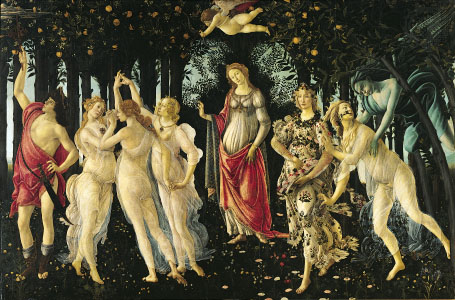
Deity of the Month: Flora

6793-004-9D79784C

Primavera, by Sandro Botticelli, c. 1477–82; in the Uffizi Gallery, Florence.


Flora was the ancient Roman goddess of flowers. Her story is chronicled in Ovid’s Fasti, Book V, when a nymph, Chloris, was kissed by the West Wind, Zephyrus, and was turned into Flora. This myth is the subject of Sandro Botticelli’s Primavera, above; Flora is the one decked in flowers, third from the right. Flora had her own festival, the Floralia, which was celebrated from April 27 to May 3 with dances, games and theatrical performances that were often lewd farces. It was considered good luck to joyfully welcome the onset of spring by offering the goddess milk and honey. Flowers decked both public and private buildings, and people wore wreaths around their necks and flowers in their hair. According to Ovid, Flora played the pivotal role in Juno’s immaculate conception of Apollo, by giving her a magic flower.

Image: Scala/Art Resource, New York.

Seneca on Saturday — bad associations ruin good characters

Statue of Lucius Annaeus Seneca the Younger,

Statue of Lucius Annaeus Seneca the Younger in Cordoba, Spain, by Amadeo Ruiz Olmos.      Photo: Gunnar Bach Pedersen, courtesy Wikimedia Commons.


EPISTLE VII: On Crowds

The young character… must be rescued from the mob; it is too easy to side with the majority. Even Socrates, Cato, and Laelius might have been shaken in their moral strength by a crowd that was unlike them; so true it is that none of us, no matter how much he cultivates his abilities, can withstand the shock of faults that approach, as it were, with so great a retinue. Much harm is done by a single case of indulgence or greed; the familiar friend, if he be luxurious, weakens and softens us imperceptibly; the neighbour, if he be rich, rouses our covetousness; the companion, if he be slanderous, rubs off some of his rust upon us, even though we be spotless and sincere. What then do you think the effect will be on character, when the world at large assaults it! You must either imitate or loathe the world. But both courses are to be avoided; you should not copy the bad simply because they are many, nor should you hate the many because they are unlike you. Withdraw into yourself, as far as you can. Associate with those who will make a better man of you. Welcome those whom you yourself can improve. The process is mutual; for men learn while they teach.

Seneca Epistles 1-65, Translation by Richard Gummere. Loeb Classical Library.


Seneca on Saturday — do as I say

Photo credit: Shakko/Wikipedia

Relief depicting Roman school, found in Roman Neumagen, near Trier, 2nd century CE. Photo credit: Shakko/Wikipedia


Epistle XCIV — On the Value of Advice

Indeed, the persons who  take the greatest pains to proffer such advice are themselves unable to put it into practice. …[I]t is the hottest-tempered school-master who contends that one should never lose one’s temper. Go to any elementary school, and you will learn that just such pronouncements, emanating from high-browed philosophers, are to be found in the lesson-book for boys!

Seneca Epistles 93-124, Translation by Richard Gummere. Loeb Classical Library.