IDEA: “A person who claims to be religious, but finds a way to justify the abduction of a 5-year-old child, is a heretic, a danger to America, and an embarrassment to his faith.” from the sermon “We are under-reacting,” by Rabbi Sharon Brous, of IKAR
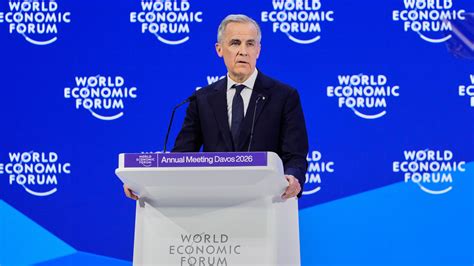
At the World Economic Forum, Prime Minister Mark Carney of Canada took a stand against US President Donald Trump, calling on medium-size countries to stand up to larger powers. Credit: Markus Schreiber/Associated Press
Excerpts from Mark Carney’s speech to the World Economic Forum at Davos:
It seems that every day we’re reminded that we live in an era of great power rivalry, that the rules-based order is fading, that the strong can do what they can, and the weak must suffer what they must. And this aphorism of Thucydides is presented as inevitable, as the natural logic of international relations reasserting itself. And faced with this logic,
there is a strong tendency for countries to go along to get along, to accommodate, to avoid trouble, to hope that compliance will buy safety. Well, it won’t.
So, what are our options?
In 1978, the Czech dissident Václav Havel, later president, wrote an essay called “The Power of the Powerless,” and in it, he asked a simple question: how did the communist system sustain itself?
And his answer began with a greengrocer. Every morning, this shopkeeper places a sign in his window: ‘Workers of the world unite’. He doesn’t believe it, no one does, but he places a sign anyway to avoid trouble, to signal compliance, to get along.
And because every shopkeeper on every street does the same, the system persists – not through violence alone, but through the participation of ordinary people in rituals they privately know to be false. Havel called this “living within a lie.”
The system’s power comes not from its truth, but from everyone’s willingness to perform as if it were true, and its fragility comes from the same source. When even one person stops performing, when the greengrocer removes his sign, the illusion begins to crack.
Friends, it is time for companies and countries to take their signs down.
For decades, countries like Canada prospered under what we called the rules-based international order. We joined its institutions, we praised its principles, we benefited from its predictability. And because of that, we could pursue values-based foreign policies under its protection. We knew the story of the international rules-based order was partially false, that the strongest would exempt themselves when convenient, that trade rules were enforced asymmetrically. And we knew that international law applied with varying rigour depending on the identity of the accused or the victim. This fiction was useful, and American hegemony, in particular, helped provide public goods, open sea lanes, a stable financial system, collective security and support for frameworks for resolving disputes.
So, we placed the sign in the window. We participated in the rituals, and we largely avoided calling out the gaps between rhetoric and reality. This bargain no longer works.
Let me be direct. We are in the midst of a rupture, not a transition.
Over the past two decades, a series of crises in finance, health, energy and geopolitics have laid bare the risks of extreme global integration. But more recently, great powers have begun using economic integration as weapons, tariffs as leverage, financial infrastructure as coercion, supply chains as vulnerabilities to be exploited.
You cannot live within the lie of mutual benefit through integration, when integration becomes the source of your subordination. The multilateral institutions on which the middle powers have relied – the WTO, the UN, the COP – the architecture, the very architecture of collective problem solving, are under threat. And as a result, many countries are drawing the same conclusions – that they must develop greater strategic autonomy, in energy, food, critical minerals, in finance and supply chains. And this impulse is understandable. A country that can’t feed itself, fuel itself or defend itself, has few options. When the rules no longer protect you, you must protect yourself.
But let’s be clear-eyed about where this leads.
A world of fortresses will be poorer, more fragile and less sustainable.
And there is another truth. If great powers abandon even the pretence of rules and values for the unhindered pursuit of their power and interests, the gains from transactionalism will become harder to replicate. Hegemons cannot continually monetize their relationships. Allies will diversify to hedge against uncertainty. They’ll buy insurance, increase options in order to rebuild sovereignty – sovereignty that was once grounded in rules, but will increasingly be anchored in the ability to withstand pressure. This room knows this is classic risk management. Risk management comes at a price, but that cost of strategic autonomy, of sovereignty can also be shared.
Collective investments in resilience are cheaper than everyone building their own fortresses.
Shared standards reduce fragmentations. Complementarities are positive sum. And the question for middle powers like Canada is not whether to adapt to the new reality – we must. The question is whether we adapt by simply building higher walls, or whether we can do something more ambitious.
Now, Canada was amongst the first to hear the wake-up call, leading us to fundamentally shift our strategic posture. Canadians know that our old comfortable assumptions that our geography and alliance memberships automatically conferred prosperity and security – that assumption is no longer valid. And our new approach rests on what Alexander Stubb, the President of Finland, has termed “value-based realism.” Or, to put another way, we aim to be both principled and pragmatic – principled in our commitment to fundamental values, sovereignty, territorial integrity, the prohibition of the use of force, except when consistent with the UN Charter, and respect for human rights, and pragmatic in recognizing that progress is often incremental, that interests diverge, that not every partner will share all of our values.
So, we’re engaging broadly, strategically with open eyes. We actively take on the world as it is, not wait around for a world we wish to be. We are calibrating our relationships, so their depth reflects our values, and we’re prioritizing broad engagement to maximize our influence, and given the fluidity of the world at the moment, the risks that this poses and the stakes for what comes next. And we are no longer just relying on the strength of our values, but also the value of our strength. We are building that strength at home.
Since my government took office, we have cut taxes on incomes, on capital gains and business investment. We have removed all federal barriers to interprovincial trade. We are fast tracking a trillion dollars of investments in energy, AI, critical minerals, new trade corridors and beyond. We’re doubling our defence spending by the end of this decade, and we’re doing so in ways that build our domestic industries.
And we are rapidly diversifying abroad. We have agreed to a comprehensive strategic partnership with the EU, including joining SAFE, the European defence procurement arrangements. We have signed 12 other trade and security deals on four continents in six months. The past few days, we’ve concluded new strategic partnerships with China and Qatar. We’re negotiating free trade pacts with India, ASEAN, Thailand, Philippines and Mercosur.
And we’re doing something else. To help solve global problems, we’re pursuing variable geometry, in other words, different coalitions for different issues based on common values and interests. So, on Ukraine, we’re a core member of the Coalition of the Willing and one of the largest per capita contributors to its defence and security. On Arctic sovereignty, we stand firmly with Greenland and Denmark, and fully support their unique right to determine Greenland’s future. Our commitment to NATO’s Article 5 is unwavering, so we’re working with our NATO allies, including the Nordic Baltic Gate, to further secure the alliance’s northern and western flanks, including through Canada’s unprecedented investments in over-the-horizon radar, in submarines, in aircraft and boots on the ground, boots on the ice. Canada strongly opposes tariffs over Greenland and calls for focused talks to achieve our shared objectives of security and prosperity in the Arctic.
On plurilateral trade, we’re championing efforts to build a bridge between the Transpacific Partnership and the European Union, which would create a new trading bloc of 1.5 billion people. On critical minerals, we’re forming buyers’ clubs anchored in the G7 so the world can diversify away from concentrated supply. And on AI, we’re cooperating with like-minded democracies to ensure that we won’t ultimately be forced to choose between hegemons and hyper-scalers. This is not naive multilateralism, nor is it relying on their institutions. It’s building coalitions that work – issues by issue, with partners who share enough common ground to act together. In some cases, this will be the vast majority of nations. What it’s doing is creating a dense web of connections across trade, investment, culture, on which we can draw for future challenges and opportunities.
Argue, the middle powers must act together, because if we’re not at the table, we’re on the menu.
But I’d also say that great powers can afford for now to go it alone. They have the market size, the military capacity and the leverage to dictate terms. Middle powers do not.
But when we only negotiate bilaterally with a hegemon, we negotiate from weakness. We accept what’s offered. We compete with each other to be the most accommodating. This is not sovereignty. It’s the performance of sovereignty while accepting subordination.
In a world of great power rivalry, the countries in between have a choice – compete with each other for favour, or to combine to create a third path with impact. We shouldn’t allow the rise of hard power to blind us to the fact that the power of legitimacy, integrity and rules will remain strong, if we choose to wield them together – which brings me back to Havel.
What does it mean for middle powers to live the truth? First, it means naming reality.
Stop invoking rules-based international order as though it still functions as advertised. Call it what it is – a system of intensifying great power rivalry, where the most powerful pursue their interests, using economic integration as coercion. It means acting consistently, applying the same standards to allies and rivals.
When middle powers criticize economic intimidation from one direction, but stay silent when it comes from another, we are keeping the sign in the window.
It means building what we claim to believe in. Rather than waiting for the old order to be restored, it means creating institutions and agreements that function as described. And it means reducing the leverage that enables coercion – that’s building a strong domestic economy. It should be every government’s immediate priority. And diversification internationally is not just economic prudence, it’s a material foundation for honest foreign policy, because countries earn the right to principled stands by reducing their vulnerability to retaliation.
So Canada. Canada has what the world wants. We are an energy superpower. We hold vast reserves of critical minerals. We have the most educated population in the world. Our pension funds are amongst the world’s largest and most sophisticated investors. In other words, we have capital, talent, we also have a government with immense fiscal capacity to act decisively. And we have the values to which many others aspire. Canada is a pluralistic society that works. Our public square is loud, diverse and free. Canadians remain committed to sustainability. We are a stable and reliable partner in a world that is anything but. A partner that builds and values relationships for the long term.
And we have something else. We have a recognition of what’s happening and a determination to act accordingly.
We understand that this rupture calls for more than adaptation. It calls for honesty about the world as it is. We are taking the sign out of the window. We know the old order is not coming back. We shouldn’t mourn it. Nostalgia is not a strategy. …
This is the task of the middle powers, the countries that have the most to lose from a world of fortresses and have most to gain from genuine co-operation.
The powerful have their power. But we have something too – the capacity to stop pretending, to name reality, to build our strength at home and to act together.
That is Canada’s path. We choose it openly and confidently, and it is a path wide open to any country willing to take it with us. Thank you very much.
This report by The Canadian Press was first published Jan. 21, 2026. The Canadian Press
Rarely do we find men who willingly engage in hard, solid thinking. There is an almost universal quest for easy answers and half-baked solutions. Nothing pains some people more than having to think…
Too many politicians in the South recognize this disease of soft mindedness that engulfs their constituency. With insidious zeal, they make inflammatory statements and disseminate distortions and half-truths that arouse abnormal fears and morbid antipathies within the minds of uneducated and underprivileged whites, leaving them so confused that they are led to acts of meanness and violence that no normal person commits.
There is little hope for us until we become tough minded enough to break loose from the shackles of prejudice, half-truths, and ignorance. The shape of the world today does not permit us the luxury of soft-mindedness. A nation or a civilization that continues to produce soft-minded men purchases its own spiritual death on an installment plan…
Soft-minded acquiescence is cowardly. My friends, we cannot win the respect of the white people of the South or elsewhere if we are willing to trade the future of our children for our personal safety and comfort. Moreover, we must learn that passively to accept an unjust system is to cooperate with that system, and thereby to become a participant in its evil.
From “A Tough Mind and a Tender Heart,” in STRENGTH TO LOVE, by Dr. Martin Luther King Jr.
Rep. Al Green, D-Texas, shouts as President Donald Trump addresses a joint session of Congress at the Capitol in Washington, Tuesday, March 4, 2025. (Win McNamee/Pool Photo via AP)
Conversation: “Democracy dies in decorum.” How the “strongbuddy” relationship between Musk and Trump is a new twist on authoritarianism needing new kinds of resistance— Anand Giridharadas and Ruth Ben-Ghiat, in the.ink
What is happening right now… is that those Senators and Members of Congress are happily giving away all Congressional authority and power to Donald Trump. They are siting silently, as Elon Musk, with his $13 billion of government contracts, uses whatever algorhythm he has to identify key words that he doesn’t like, and just starts cutting programs. We all would love to address waste, fraud, and abuse. We’d love to address government efficiency. But you cannot sit here, not a single one of my Republican colleagues can sit here and say you know what Elon Musk is cutting, that you know it to be waste, fraud, and abuse. You don’t: nobody does! He doesn’t even know if it’s waste fraud and abuse. Because there’s no investigation, there’s no evaluation. Instead, he’s just cutting.
And you all sit there silently: letting some unelected billionaire get access to our personal identification information, cut programs willy nilly, cut funding… potentially stop funding. I don’t understand… on what planet do you stop the funding for a program, and then investigate it? Why aren’t you investigating it while it continues, so the status quo can continue? So that Americans who rely on this money can continue to believe they will have this money. And in many cases that Congress appropriated, and designated, and obligated, and they’re stomping all over that down at 1600 Pennsylvania.
And there isn’t a single Republican member of Congress who’s willing to stand up for Congress. For us! For Congress! Just because Donald has designated Elon Musk to do the work, and you’re either afraid that Donald Trump will support a primary opponent, or you’re afraid that Elon Musk will put $10 million into a primary opponent. And so you happily turn over all of your own authority. What is the point of being here? Why do you run for office? Why do you want to be elected to Congress? So that you can bend the knee to the executive? So you can bend the knee to Donald Trump?
There’s no mandate for Congress hiding in a cave. The mandate is to address the issues that the American people are facing. Which is inflation, which are high costs, which is affordability. And if you want to address waste, fraud, and abuse, we’re happy to do it with you. The right way: by coming back to Congress, and showing us what’s wasteful, what’s fraudulent, what’s abuse. So that we can vote, as the owners of the power of the purse, to make those decisions.
Everybody knows that Trump’s victory was not a mandate that has not been seen in many decades. And Trump goes on to talk about how all of a sudden we finally have most Americans believing the country is headed in the right direction rather than the wrong one….
The point of these kinds of lies, which are so easy to check, is, one, to overwhelm the system’s faculties of truth. At a certain point, you give up.
This is what it means, as Steve Bannon said, to “flood the zone” of [expletive]. You can check a couple of lies if all you’re doing is checking every sentence of a two-hour speech. You’re going to bore your audience and yourself.
These are more like what was happening when Trump made Sean Spicer go out in the first term and say it was the largest inauguration crowd ever. It is a way of cleaving reality into two. These lies are loyalty tests. They’re ways of getting people who accept them — JD Vance chuckling right behind him — further and further into the con.
Because once you’ve given up so much of yourself, once you’ve traded little shred of dignity after little shred of dignity, once you’ve accepted these cruelties and outrageous things you would not have thought you would have accepted a couple of years before — at a certain point, you’re in too deep, you’ve gone too far. You’ve cut yourself off from old sources of support, from old versions of your own internal ethic and your own internal self-esteem and self-conception.
And now really all you have as a Republican politician or a staffer is the success of Donald Trump. You’ve thrown so much money into this that it really better work out.
That’s what I think this lying is. It’s really not about Donald Trump trying to give you a sense of the world. He knows perfectly well that people can see what is happening to the stock market. They don’t think on that particular day: We are in a new golden age where everything is going great.
What he is doing is breaking the system into those who are loyal to him and those who are not, and then those who are not can be sort of purged — at least if they’re on the Republican side — one by one by one by one.
The stars of ‘Oppenheimer,’ ‘The Brutalist,’ ‘Anora’ and ‘Poor Things’ deserve their accolades, but there’s a disturbing pattern here…
If Kamala Harris were president right now, these wins might merit a shrug. But given that every branch of the U.S. government and now military is currently headed up by a person possessed of XY chromosomes who has been held liable for sexual abuse, and his cabinet includes multiple men accused of sexual assault, it’s difficult not to conclude that, even outside of Hollywood, women have been demoted.
Hollywood, too, has done better in the past. Between 2021 and 2023, Michelle Yeoh, Frances McDormand, and Jessica Chastain won Oscars for playing a sci-fi warrior, a nomadic widow, and a televangelist, respectively. And in the recent past, we’ve seen top actresses take star turns as larger-than-life figures like Katherine Graham, Queen Elizabeth, and Erin Brockovich….
Going into this year’s Oscars, the big question was whether Madison would win for best actress or the honor would go to 1980s “it-girl” Demi Moore for her unsettling performance in the horror film The Substance. Playing an over-50 TV fitness instructor who is laid off for age-related reasons, Moore is so desperate to reclaim her lost youth that she willingly injects a mysterious substance into herself, which causes her to violently vacate her body and intermittently inhabit that of a dewy woman half her age (played by Margaret Qualley). Insofar as Moore’s character soon discovers that everyone wants a piece of her nubile self, not her authentic menopausal one, it appeared to some moviegoers this week that the Oscar going to 25-year-old Madison, not 62-old Moore, precisely mirrored the message of the movie.
But the larger irony here may be that Moore and Madison’s roles aren’t that far apart: Both presume a universe where a woman’s only value lies in her firm flesh and sexual allure, her character and intellect be damned. This is also a universe in which female friendship and camaraderie are either nonexistent or in short supply.
It’s the job of the Oscars to celebrate the best performances, wherever they are found. And both Madison and Stone were stand-outs. But the film world also needs to consider its role in reinforcing this backlash moment — a moment where the Manosphere has replaced #MeToo. And the only women who appear to have political power are Barbified stooges and mouthpieces for a president who, in addition to being a budding autocrat and sex pest, once owned beauty pageants. Trump is also known for rating women’s bodies on a scale of 1 to 10, as if they were show horses, and not human beings.
Given the current dystopia, any cause for celebration should be embraced. Still, it matters what is being celebrated. Right now, we need more stories about women triumphing in all sorts of arenas, not just ones that insist on reducing them to sexual objects. Hollywood, get on it!
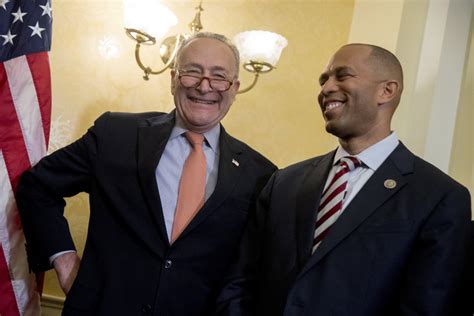
Senate Minority Leader Chuck Schumer, and House Minority Leader Hakeem Jeffries. Andrew Harnik/AP Photo
ENGAGE:
Come On!:Democrats: This Is War: Isn’t It About Time You Started Acting Like It? — Michael Tomasky. “No, Democrats. No sitting around and waiting for things to change. Help make them change. Public opinion will shift more quickly if you kindle that shift… Democrats rarely try to force a change in the way voters see an issue. They rarely play the role of disruptors. Well, folks, if ever history was grabbing you by the lapels and demanding that you do some disrupting, it’s now. And if the hearts and minds of the working class constitute the main front in our political battle, how about a weekly press conference by Democrats ticking off the ways in which the administration has made things worse for working-class people? Trump has stripped the National Labor Relations board of a quorum, meaning that it can’t defend workers’ rights. People don’t care? Nonsense. Choose a couple emotionally charged examples that will make them care.”
Fear, Chaos and Capture:Trump’s American Takeover —Amicus Podcast, with Dahlia Lithwick, an interview with Kim Lane Scheppele, Trump’s moves follow the authoritarian playbook in Hungary, Russia, Venezuela, in which an authoritarian is democratically elected, changes the constitution, and then cancels all legal precedents. “It’s important to keep toeholds that you can use to leverage into more power for the opposition… civil sector groups, state governments in blue states, anything that has not yet been captured… we should lean into the parts of the government that are not gonna go down without a fight…. look at where public outrage can at least gum up the works. Everything that this administration does now that is bringing down democracy and causing pain should be met with friction. You may not be able to stop it, but you can slow it down.”
Scapegoats:Trump’s Boogeyman: D.E.I.— The New Yorker Radio Hour Podcast. David Remnick interviews Jelani Cobb, Dean of Columbia School of Journalism, who says: “Morale is not great [among journalists]. We should never allow young or emerging journalists to have the idea that there’s a one to one relationship between our effort and the outcome…. We don’t know what the ratio is — it’s unknowable, unpredictable, completely random. And my version of encouragement has been that we keep doing the work until we get to that breakthrough moment where it actually really, really does make a difference.”
Move Fast and Break Things.How WIRED Magazine is Scooping the Competition, plus Whither the Democrats? On the Media Podcast. Brook Gladstone interviews Ezra Levin, of Indivisible, on Congressional Democrats’ “Stop the Steal” bill: “Nobody with even a passing understanding or familiarity with how Congress works, believes this bill is ever gonna get a vote; nobody believes if this bill got a vote that it would pass; nobody believes that if it passed that Donald Trump would sign it; nobody believes that if he vetoed it that Congress would override it; and nobody believes that if Congress even succeeded in overriding it, that Trump would agree to implement it. What this bill does is say, ‘I’m Chuck Schumer, I’m Hakeem Jeffries: I care.’ I don’t care that you care; I care that you’re using the power available to you.” Indivisible suggests using Mitch McConnell’s playbook to push back.





 Valerie Block