The excavations were empty on the sweltering afternoon in July my husband and I visited Herculaneum. Just a stray dog, a bride and groom posing for photos in front of arches, a caretaker of the ruins, and us.

Herculaneum, photo courtesy of yourbesttravel.com
Archeologist Andrew Wallace-Hadrill, director of the Herculaneum Conservation Project, has written that because of the position of the two towns in relation to the volcano Vesuvius, “[t]he freak chance that Pompeii was blanketed in ash and pumice pebbles, while Herculaneum was covered in the fine, hot dust of pyroclastic surges and flows, resulted in the extensive preservation at Herculaneum of organic material —principally wood, but also foodstuffs, papyrus and cloth.” He adds that the depth of volcanic material that covered Herculaneum was three or four times greater than that of Pompeii, thus preserving some buildings several storeys above street level. Some buildings are so well-preserved, in fact, you might forget you are in an excavation.
Did I mention it was hot? At 5:30, the heat was pulsating off the 2,000-year-old paving stones as I crossed from a fully-intact ancient apartment block to some shade in front of a bakery on the other side of the street. I suddenly had the feeling that I was living there.
I don’t believe in past lives
I don’t mean that I had a memory of a past life in ancient Rome —I don’t believe in past lives. I mean that I felt like I was living in Herculaneum now, on my way from my apartment to the bakery, naturally seeking shade as I walked down the street. It was an odd feeling, and I dismissed it.
But a few days later, in the basement of the Palazzo dei Conservatori in Rome, I was hit with another odd sensation. The epigraphic gallery is a long space lined with tombstones and echoing with the voices of bored teenagers. The epitaphs were helpfully translated from Latin into English: “For the souls departed. May trickery and fraud stay away from this funerary monument,” and “I wish that the earth does not weigh heavily upon your remains.” I was struck by the names (Crustuminius!) the pompous language (“employed as the keeper of the storerooms of the Green Faction”), the colorful variety of professions (“Domitia, maker and seller of scented oils”) and the sad accounting of time (“H, who lived 32 years, 5 months, 21 days, his brother Heres saw to the making of this tomb”). As I passed from one tombstone to the next, the voices in the gallery got louder, and it felt like the ancient people represented were jockeying for my interest, calling out, “Hey: Pay attention to me! This was my life.”
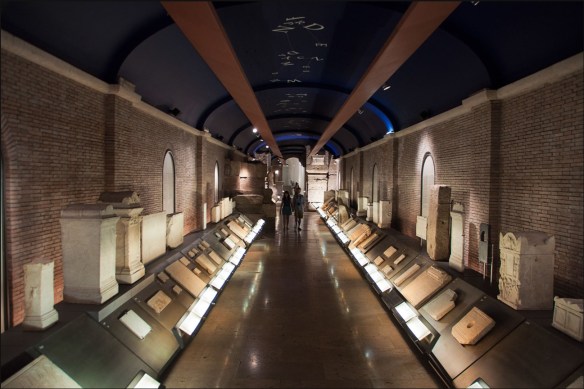
The Epigraphic gallery at the Palazzo dei Conservatori, Rome. Photo courtesy of Chris Oler, via Pinterest
A story begins to brew
I returned home with a story brewing, a story about power, status and expectations; it was ancient Rome, so of course there were two feuding brothers. For some reason, I knew that the story had to be told in documents that I would create —letters, invitations, menus, petitions to the Emperor, etc. I have no idea why I was so sure about that, but there is so much self-doubt when writing a novel, if you have absolute certainty about anything, you have to just run with it. I had written three novels of contemporary comic fiction. This leap into ancient historical bloodletting was daring and new, and for a while I sped along, soaking up facts in books, museums and papyri, enthralled by the mysteries of ancient life.
I’ve always been fascinated and repulsed by ancient Rome in equal measure. The Romans were arrogant, brutal, greedy, ostentatious and corrupt. Roman citizens were protected by the rule of law, but those in power routinely disregarded the law with impunity. The Roman aristocracy was ferociously proud of its independence, yet permitted itself to be stripped of all authority by a series of dictators and emperors. Roman engineering was legendarily meticulous, yet the Roman legions demolished the works of others with wanton disrespect. The society was drenched in status anxiety; even among slaves there was a class hierarchy. Ancient Roman culture spanned the heights of rationality and the depths of cruelty. I was riveted.
Rome was not built in a day
Then, like Wiley Coyote, who continues to run in mid-air, crashing only once he notices that he has left the cliff, I saw the gulf between me and everything I didn’t know, panicked, and dropped straight down. The combination of new genre, new format and the imperative of historical accuracy weighed heavily on me. I told myself: Whatever you don’t know, you’ll learn. Rome wasn’t built in a day, and look: it took hundreds of years to destroy!
On the other hand, enough already: I have been finishing this book for far too long. I am pleased to FINALLY announce that the book that began as an odd feeling in front of a bakery in Herculaneum (I won’t say how many years ago) is now fully cooked. I’ll be taking it out into the world shortly. Stay tuned.



 Valerie Block