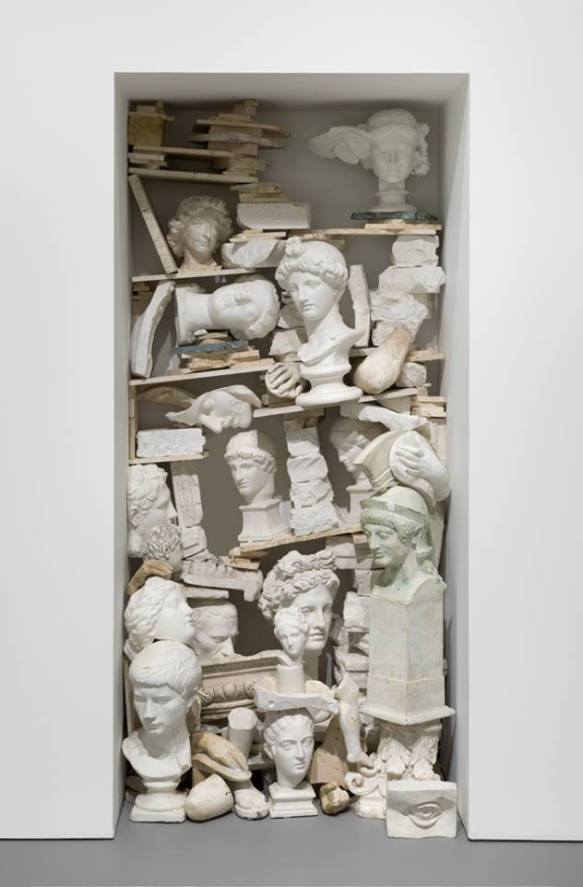
“Untitled,” 1980, by Jannis Kounellis, at the Smithsonian’s Hirschhorn Museum and Sculpture Garden, Washington DC. Photo from Tumblr.

“Untitled,” 1980, by Jannis Kounellis, at the Smithsonian’s Hirschhorn Museum and Sculpture Garden, Washington DC. Photo from Tumblr.
 Epistle LXXII. On business as the enemy of philosophy
For there is never a moment when fresh employments will not come along; we sow them, and for this reason several spring up from one. Then, too, we keep adjourning our own cases, saying “as soon as I am done with this, I shall settle down to hard work,” or: “If I ever set this troublesome matter in order, I shall devote myself to study”
But the study of philosophy is not to be postponed until you have leisure; everything else is to be neglected in order that we may attend to philosophy, for no amount of time is long enough for it… We must resist the affairs which occupy our time; they must not be untangled, but rather put out of the way. Indeed, there is no time that is unsuitable for helpful studies; and yet many a man fails to study amid the very circumstances which make study necessary.
Seneca Epistles 66-92, Translation by Richard Gummere. Loeb Classical Library.
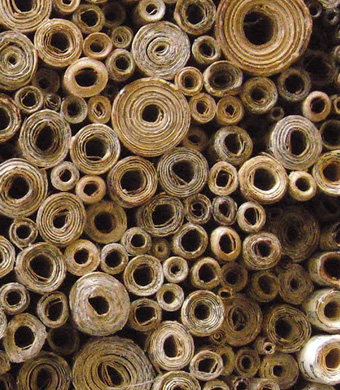
The subject concerning which you question me was once clear to my mind, and required no thought, so thoroughly had I mastered it. But I have not tested my memory of it for some time, and therefore it does not readily come back to me. I feel that I have suffered the fate of a book whose rolls have stuck together by disuse; my mind needs to be unrolled, and whatever has been stored away there ought to be examined from time to time, so that it may be ready for use when occasion demands. Let us therefore put this subject off for the present; for it demands much labour and much care. As soon as I can hope to stay for any length of time in the same place, I shall then take your question in hand. For there are certain subjects about which you can write even while traveling in a gig, and there are also subjects which need a study-chair, and quiet, and seclusion.
Seneca Epistles 66-92, Translation by Richard Gummere. Loeb Classical Library.

Cultural Analysis: La Bella Figura: A Field Guide to the Italian Mind — Beppe Severgnini
Fiction: Dear Committee Members — Julie Schumacher
Non-fiction: How To Age (The School of Life) — Anne Karpf
Documentary: When Two Worlds Collide — Heidi Brandenburg and Matthew Orzel
Movie: Sing Street — John Carney
Music: Bonfires on the Heath — the Clientele.
Not-So-Ancient Inspiration: “If you never encounter anything in your community that offends you, then you are not living in a free society.” — Kim Campbell
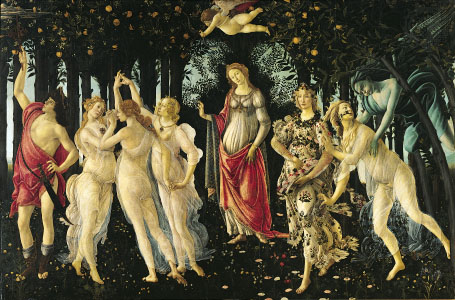
Primavera, by Sandro Botticelli, c. 1477–82; in the Uffizi Gallery, Florence.
Flora was the ancient Roman goddess of flowers. Her story is chronicled in Ovid’s Fasti, Book V, when a nymph, Chloris, was kissed by the West Wind, Zephyrus, and was turned into Flora. This myth is the subject of Sandro Botticelli’s Primavera, above; Flora is the one decked in flowers, third from the right. Flora had her own festival, the Floralia, which was celebrated from April 27 to May 3 with dances, games and theatrical performances that were often lewd farces. It was considered good luck to joyfully welcome the onset of spring by offering the goddess milk and honey. Flowers decked both public and private buildings, and people wore wreaths around their necks and flowers in their hair. According to Ovid, Flora played the pivotal role in Juno’s immaculate conception of Apollo, by giving her a magic flower.
Image: Scala/Art Resource, New York.

Statue of Lucius Annaeus Seneca the Younger in Cordoba, Spain, by Amadeo Ruiz Olmos. Photo: Gunnar Bach Pedersen, courtesy Wikimedia Commons.
EPISTLE VII: On Crowds
The young character… must be rescued from the mob; it is too easy to side with the majority. Even Socrates, Cato, and Laelius might have been shaken in their moral strength by a crowd that was unlike them; so true it is that none of us, no matter how much he cultivates his abilities, can withstand the shock of faults that approach, as it were, with so great a retinue. Much harm is done by a single case of indulgence or greed; the familiar friend, if he be luxurious, weakens and softens us imperceptibly; the neighbour, if he be rich, rouses our covetousness; the companion, if he be slanderous, rubs off some of his rust upon us, even though we be spotless and sincere. What then do you think the effect will be on character, when the world at large assaults it! You must either imitate or loathe the world. But both courses are to be avoided; you should not copy the bad simply because they are many, nor should you hate the many because they are unlike you. Withdraw into yourself, as far as you can. Associate with those who will make a better man of you. Welcome those whom you yourself can improve. The process is mutual; for men learn while they teach.
Seneca Epistles 1-65, Translation by Richard Gummere. Loeb Classical Library.
 Valerie Block