Seneca on Monday — the key to peace of mind

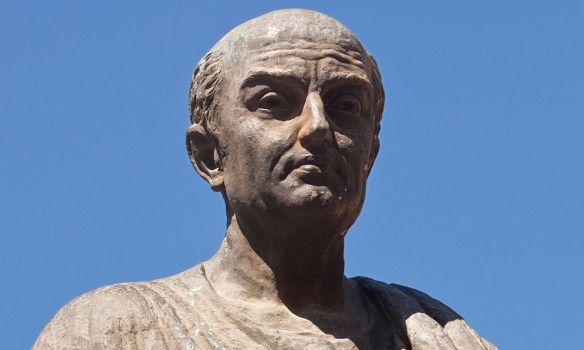
Statue of Lucius Annaeus Seneca the Younger,

Statue of Lucius Annaeus Seneca the Younger in Cordoba, Spain, by Amadeo Ruiz Olmos

CV. On Facing the World with Confidence

The most important contribution to peace of mind is never to do wrong. Those who lack self-control lead disturbed and tumultuous lives; their crimes are balanced by their fears, and they are never at ease. For they tremble after the deed, and they are embarrassed; their consciences do not allow them to busy themselves with other matters, and continually compel them to give an answer. Whoever expects punishment, receives it, but whoever deserves it, expects it. Where there is an evil conscience something may bring safety, but nothing can bring ease; for a man imagines that, even if he is not under arrest, he may soon be arrested. His sleep is troubled; when he speaks of another man’s crime, he reflects upon his own, which seems to him not sufficiently blotted out, not sufficiently hidden from view. A wrongdoer sometimes has the luck to escape notice but never the assurance thereof.

Seneca Epistles 93-124, Translation by Richard Gummere. Loeb Classical Library.

Photo credit: Gunnar Bach Pedersen, courtesy Wikimedia Commons.

Seneca on Saturday — the dangers of chat

Mosaic from the Villa dei Casale, Piazza Armerina, Sicily. 3-4th century CE.

Mosaic from the Villa dei Casale, Piazza Armerina, Sicily. 3-4th century CE.

CV. On Facing the World with Confidence

Nothing, however, will help you so much as keeping still –talking very little with others, and as much as may be with yourself. For there is a sort of charm about conversation, something very subtle and coaxing, which, like intoxication or love, draws secrets from us. No man will keep to himself what he hears. No one will tell another only as much as he has heard. And he who tells tales will tell names, too. Everyone has someone to whom he entrusts exactly what has been entrusted to him. Though he checks his own garrulity, and is content with one hearer, he will bring about him a nation, if that which was a secret shortly before becomes common talk.

Seneca Epistles 93-124, Translation by Richard Gummere. Loeb Classical Library.


Seneca on Saturday — how to avoid envy II

5-1_2

Mosaic in front of a fish monger’s shop in the Piazza of Corporations, Ostia Antica, 3rd century CE. The image is of a dolphin with a fish and an octopus in its jaws. “IMBIDE CALCO TE” means “Envious one, I tread on you.” Photo credit: Eric Taylor, from http://www.ostia-antica.org.

CV. On Facing the World with Confidence

Contempt remains to be discussed. He who has made this quality an adjunct of his own personality, who is despised because he wishes to be despised and not because he must be despised, has the measure of contempt under control. Any inconveniences in this respect can be dispelled by honourable occupations and by friendships with men who have influence with an influential person; with these men it will profit you to engage but not to entangle yourself, lest the cure may cost you more than the risk.

Seneca Epistles 93-124, Translation by Richard Gummere. Loeb Classical Library.

Seneca on Saturday — how to avoid envy

5-1_2

Mosaic in front of a fish monger’s shop in the Piazza of Corporations, Ostia Antica, 3rd century CE. The image is of a dolphin with a fish and an octopus in its jaws. “IMBIDE CALCO TE” means “Envious one, I tread on you.” Photo credit: Eric Taylor, from http://www.ostia-antica.org.

CV. On Facing the World with Confidence

Reflect on the things which goad man into destroying man: you will find that they are hope, envy, hatred, fear, and contempt. Now, of all these, contempt is the least harmful, so much so that many have skulked behind it as a sort of cure. When a man despises you, he works you injury, to be sure, but he passes on; and no one persistently or of set purpose does hurt to a person whom he despises. Even in battle, prostrate soldiers are neglected: men fight with those who stand their ground. And you can avoid the envious hopes of the wicked so long as you have nothing which can stir the evil desire of others, and so long as you possess nothing remarkable. For people crave even little things, if these catch the attention or of rare occurrence.

You will escape envy if you do not force yourself on the public view, if you do not boast your possessions, if you understand how to enjoy things privately. Hatred comes either from running foul of others: and this can be avoided by never provoking anyone; or else it is uncalled for: and common-sense will keep you safe from it. Yet it has been dangerous to many; some people have been hated without having had an enemy. As to not being feared, a moderate fortune and an easy disposition will guarantee you that; men should know that you are the sort of person who can be offended without danger; and your reconciliation should be easy and sure. Moreover, it is as troublesome to be feared at home as abroad; it is as bad to be feared by a slave as by a gentleman. For everyone has strength enough to do you some harm. Besides, he who is feared, fears also; no one has been able to arouse terror and live with peace of mind.

Seneca Epistles 93-124, Translation by Richard Gummere. Loeb Classical Library.

Seneca on Saturday: when the mind needs to be unrolled and examined

academic-writing-scrolls

Epistle LXXII. On business as the enemy of philosophy

The subject concerning which you question me was once clear to my mind, and required no thought, so thoroughly had I mastered it. But I have not tested my memory of it for some time, and therefore it does not readily come back to me. I feel that I have suffered  the fate of a book whose rolls have stuck together by disuse; my mind needs to be unrolled, and whatever has been stored away there ought to be examined from time to time, so that it may be ready for use when occasion demands. Let us therefore put this subject off for the present; for it demands much labour and much care. As soon as I can hope to stay for any length of time in the same place, I shall then take your question in hand. For there are certain subjects about which you can write even while traveling in a gig, and there are also subjects which need a study-chair, and quiet, and seclusion.

Seneca Epistles 66-92, Translation by Richard Gummere. Loeb Classical Library.

Seneca on Saturday — bad associations ruin good characters

Statue of Lucius Annaeus Seneca the Younger,

Statue of Lucius Annaeus Seneca the Younger in Cordoba, Spain, by Amadeo Ruiz Olmos.      Photo: Gunnar Bach Pedersen, courtesy Wikimedia Commons.


EPISTLE VII: On Crowds

The young character… must be rescued from the mob; it is too easy to side with the majority. Even Socrates, Cato, and Laelius might have been shaken in their moral strength by a crowd that was unlike them; so true it is that none of us, no matter how much he cultivates his abilities, can withstand the shock of faults that approach, as it were, with so great a retinue. Much harm is done by a single case of indulgence or greed; the familiar friend, if he be luxurious, weakens and softens us imperceptibly; the neighbour, if he be rich, rouses our covetousness; the companion, if he be slanderous, rubs off some of his rust upon us, even though we be spotless and sincere. What then do you think the effect will be on character, when the world at large assaults it! You must either imitate or loathe the world. But both courses are to be avoided; you should not copy the bad simply because they are many, nor should you hate the many because they are unlike you. Withdraw into yourself, as far as you can. Associate with those who will make a better man of you. Welcome those whom you yourself can improve. The process is mutual; for men learn while they teach.

Seneca Epistles 1-65, Translation by Richard Gummere. Loeb Classical Library.