Seneca on Saturday — fear and hope

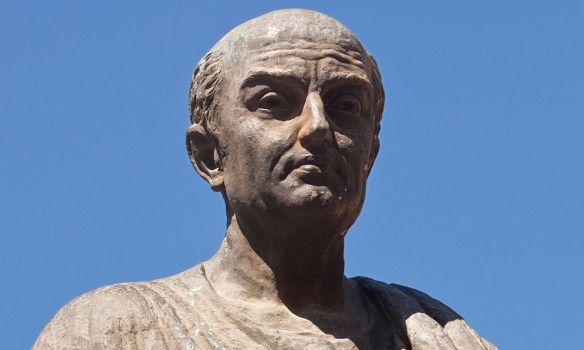
Statue of Lucius Annaeus Seneca the Younger,

Statue of Lucius Annaeus Seneca the Younger in Cordoba, Spain, by Amadeo Ruiz Olmos

Lord Macaulay once said that Seneca the Younger was easily quotable, but reading him straight through would be like “dining on nothing but anchovy sauce.” I agree! Thus I present some of the condensed wit and wisdom of Seneca, every Saturday.


EPISTLE  V. The philosopher’s mean, Part II.

Just as the same chain fastens the prisoner and the soldier who guards him, so hope and fear, dissimilar as they are, keep step together; fear follows hope. I am not surprised that they proceed in this way; each alike belongs to a mind that is in suspense, a mind that is fretted by looking forward to the future. But the chief cause of both these ills is that we do not adapt ourselves to the present, but send our thoughts a long way ahead. … The present alone can make no man wretched.

Seneca Epistles 1-65, Translation by Richard Gummere. Loeb Classical Library.

Photo credit: Gunnar Bach Pedersen, courtesy Wikimedia Commons.

Seneca on Saturday — Holidays haven’t changed much

Statue of Lucius Annaeus Seneca the Younger,

Statue of Lucius Annaeus Seneca the Younger in Cordoba, Spain, by Amadeo Ruiz Olmos

Lord Macaulay once said that Seneca the Younger was easily quotable, but reading him straight through would be like “dining on nothing but anchovy sauce.” I agree! Thus I present some of the condensed wit and wisdom of Seneca, every Saturday.


***

From Epistle XVIII, On Festivals and Fasting

It is the month of December, and yet the city is at this very moment in a sweat. License is given to the general merrymaking. Everything resounds with mighty preparations, — as if the Saturnalia differed at all from the usual business day! So true is it that the difference is nil, that I regard as correct the remark of the man who said: “Once December was a month; now it is a year.”

… the surest proof which a man can get of his own constancy [is] if he neither seeks the things which are seductive and allure him to luxury, nor is led into them. It shows much more courage to remain dry and sober when the mob is drunk and vomiting; but it shows greater self-control to refuse to withdraw oneself and to do what the crowd does, but in a different way, — thus neither making oneself conspicuous nor becoming one of the crowd. For one may keep holiday without extravagance.”

Seneca Epistles 1-65, Translation by Richard Gummere. Loeb Classical Library.

Photo credit: Gunnar Bach Pedersen, courtesy Wikimedia Commons.

Seneca on Saturday — over- and under-sharing

Statue of Lucius Annaeus Seneca the Younger,

Statue of Lucius Annaeus Seneca the Younger in Cordoba, Spain, by Amadeo Ruiz Olmos

Lord Macaulay once said that Seneca the Younger was easily quotable, but reading him straight through would be like “dining on nothing but anchovy sauce.” I agree! Thus I present some of the condensed wit and wisdom of Seneca, every Saturday.

***

EPISTLE III. On True and False Friendship

You have sent a letter to me through the hand of a “friend” of yours, as you call him. And in your very next sentence you warn me not to discuss with him all the matters that concern you, saying that even you yourself are not accustomed to do this; in other words, you have in the same letter affirmed and denied that he is your friend. Now if you used this word of ours in the popular sense, and called him “friend” in the same way in which we speak of all candidates for election as “honourable gentlemen,” and as we greet all men whom we meet casually, if their names slip us for the moment, with the salutation “my dear sir,” – so be it. But if you consider any man a friend whom you do not trust as you trust yourself, you are mightily mistaken and you do not sufficiently understand what true friendship means….

Ponder for a long time whether you shall admit a given person to your friendship; but when you have decided to admit him, welcome him with all your heart and soul. …Regard him as loyal, and you will make him loyal. …

There is a class of men who communicate, to anyone whom they meet, matters which should be revealed to friends alone, and unload upon the chance listener whatever irks them. Others, again, fear to confide in their closest intimates; and if it were possible, they would not trust even themselves, burying their secrets deep in their hearts. But we should do neither. …

In like manner you should rebuke these two kinds of men, – both those who always lack repose, and those who are always in repose. For love of bustle is not industry, – it is only the restlessness of a hunted mind. And true repose does not consist in condemning all motion as merely vexation; that kind of repose is slackness and inertia.

Seneca Epistles 1-65, Translation by Richard Gummere. Loeb Classical Library.

Photo credit: Gunnar Bach Pedersen, courtesy Wikimedia Commons.