With unwashed feet

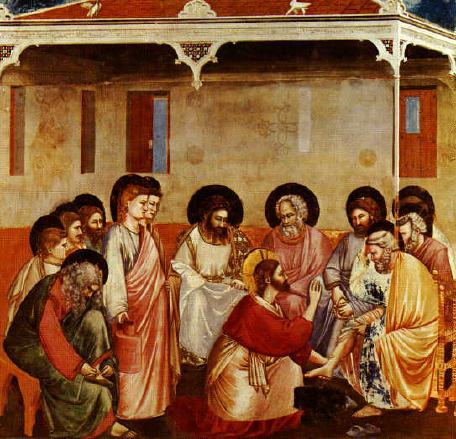
Giotto di Bondone, “Washing of Feet,” 1304-06. Cappella Scrovegni (Arena Chapel), Padua, Italy.


In the ancient world, hand and foot washing of guests or travelers was an act of hospitality, the sign of a meal to come. When Romans arrived at a banquet, their shoes were removed by slaves, who washed their feet and replaced the shoes, only to remove them again when the guests arrived in the dining room and lay down to eat on couches. In PetroniusSatyricon, the foot washing slaves perform something of a pedicure for the guests. Foot washing always had servile connotations. In the Gospel According to John, when Jesus bent down to wash the feet of his disciples at the last supper, Simon Peter was scandalized. “Peter said to Him, “Never shall You wash my feet! Jesus answered him, “If I do not wash you, you have no part with Me” (John 13:8).

Foot washing was also a sign of preparation, hence the saying, “with unwashed feet,” to describe someone who jumps into a task without thinking.


Seneca on Saturday — how to avoid envy

5-1_2

Mosaic in front of a fish monger’s shop in the Piazza of Corporations, Ostia Antica, 3rd century CE. The image is of a dolphin with a fish and an octopus in its jaws. “IMBIDE CALCO TE” means “Envious one, I tread on you.” Photo credit: Eric Taylor, from http://www.ostia-antica.org.

CV. On Facing the World with Confidence

Reflect on the things which goad man into destroying man: you will find that they are hope, envy, hatred, fear, and contempt. Now, of all these, contempt is the least harmful, so much so that many have skulked behind it as a sort of cure. When a man despises you, he works you injury, to be sure, but he passes on; and no one persistently or of set purpose does hurt to a person whom he despises. Even in battle, prostrate soldiers are neglected: men fight with those who stand their ground. And you can avoid the envious hopes of the wicked so long as you have nothing which can stir the evil desire of others, and so long as you possess nothing remarkable. For people crave even little things, if these catch the attention or of rare occurrence.

You will escape envy if you do not force yourself on the public view, if you do not boast your possessions, if you understand how to enjoy things privately. Hatred comes either from running foul of others: and this can be avoided by never provoking anyone; or else it is uncalled for: and common-sense will keep you safe from it. Yet it has been dangerous to many; some people have been hated without having had an enemy. As to not being feared, a moderate fortune and an easy disposition will guarantee you that; men should know that you are the sort of person who can be offended without danger; and your reconciliation should be easy and sure. Moreover, it is as troublesome to be feared at home as abroad; it is as bad to be feared by a slave as by a gentleman. For everyone has strength enough to do you some harm. Besides, he who is feared, fears also; no one has been able to arouse terror and live with peace of mind.

Seneca Epistles 93-124, Translation by Richard Gummere. Loeb Classical Library.

Arriving late to a classical education

tumblr_nnkr0nHkhD1qirr5yo1_1280

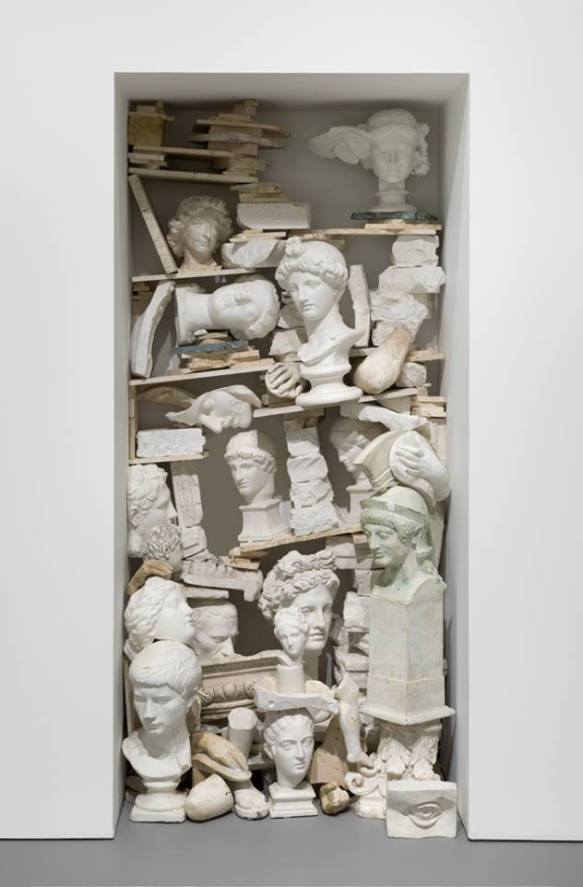
“Untitled,” 1980, by Jannis Kounellis, at the Smithsonian’s Hirschhorn Museum and Sculpture Garden, Washington DC. Photo from Tumblr.

Seneca on Saturday: procrastinate later

academic-writing-scrollsEpistle LXXII. On business as the enemy of philosophy

For there is never a moment when fresh employments will not come along; we sow them, and for this reason several spring up from one. Then, too, we keep adjourning our own cases, saying “as soon as I am done with this, I shall settle down to hard work,” or: “If I ever set this troublesome matter in order, I shall devote myself to study”

But the study of philosophy is not to be postponed until you have leisure; everything else is to be neglected in order that we may attend to philosophy, for no amount of time is long enough for it… We must resist the affairs which occupy our time; they must not be untangled, but rather put out of the way. Indeed, there is no time that is unsuitable for helpful studies; and yet many a man fails to study amid the very circumstances which make study necessary.

Seneca Epistles 66-92, Translation by Richard Gummere. Loeb Classical Library.
Seneca on Saturday: when the mind needs to be unrolled and examined

academic-writing-scrolls

Epistle LXXII. On business as the enemy of philosophy

The subject concerning which you question me was once clear to my mind, and required no thought, so thoroughly had I mastered it. But I have not tested my memory of it for some time, and therefore it does not readily come back to me. I feel that I have suffered  the fate of a book whose rolls have stuck together by disuse; my mind needs to be unrolled, and whatever has been stored away there ought to be examined from time to time, so that it may be ready for use when occasion demands. Let us therefore put this subject off for the present; for it demands much labour and much care. As soon as I can hope to stay for any length of time in the same place, I shall then take your question in hand. For there are certain subjects about which you can write even while traveling in a gig, and there are also subjects which need a study-chair, and quiet, and seclusion.

Seneca Epistles 66-92, Translation by Richard Gummere. Loeb Classical Library.
Method and Motivation: the moral of the story

horses-1348284_960_720


As a thinking person, I really do dislike being manipulated by stories. It’s one of my main beefs against Disney. As a mother on stage at bedtime, however, I frequently find myself violating all my own higher standards of storytelling. Like many parents, I am exhausted, impatient and creatively challenged at bedtime, so if I do take the time to create a story, I fling myself onto that moral like a life raft. It just comes out of me, and I am appalled at myself.

I created a whole series of tales featuring Shasta, a young pony with a knack for getting into trouble. The jewel in the crown of this franchise was “Baby Pony Shas and the Unexpected Ring of Fire,” which tells how Baby Pony Shas was playing in the living room one morning when his mother was on the phone, for work, in the kitchen. Suddenly, the intoxicating smell of wood smoke beckoned him and, despite his mother’s warning to stay inside and to not –under any circumstances!– open the door or leave the house, Baby Pony Shas found himself doing just that, and following the lovely smell down streets lined with beautiful trees turning amazing shades of orange, yellow and red, to Mountainside Park, where there was a bonfire going, which felt really nice in the cool October air, and then suddenly, suddenly! Baby Pony Shas was surrounded by a ring of flames leaping ten feet high!

I will not insult you by giving you the moral of that story. (But it ends with Baby Pony Shas safely at home, deeply penitent.) As a writer, as a reader, I have nothing but disdain for manipulation and formulas. But as a parent, I need all the help I can get. What about you? Do you tell your own stories with morals, or gravitate to “The Boy Who Cried Wolf ” at bedtime?