May Word of Mouth

51BHKP2JW4L._SX312_BO1,204,203,200_

Cultural Analysis: La Bella Figura: A Field Guide to the Italian MindBeppe Severgnini

Fiction: Dear Committee MembersJulie Schumacher

Non-fiction: How To Age (The School of Life)Anne Karpf

Documentary: When Two Worlds Collide — Heidi Brandenburg and Matthew Orzel

Movie: Sing Street — John Carney

Music: Bonfires on the Heath — the Clientele.

Not-So-Ancient Inspiration: If you never encounter anything in your community that offends you, then you are not living in a free society.” — Kim Campbell

Deity of the Month: Flora

6793-004-9D79784C

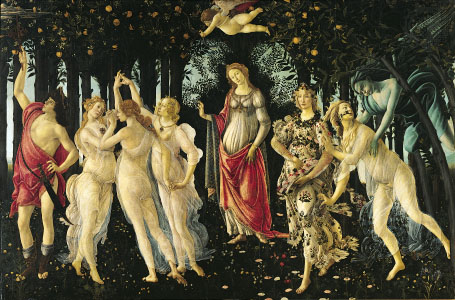
Primavera, by Sandro Botticelli, c. 1477–82; in the Uffizi Gallery, Florence.


Flora was the ancient Roman goddess of flowers. Her story is chronicled in Ovid’s Fasti, Book V, when a nymph, Chloris, was kissed by the West Wind, Zephyrus, and was turned into Flora. This myth is the subject of Sandro Botticelli’s Primavera, above; Flora is the one decked in flowers, third from the right. Flora had her own festival, the Floralia, which was celebrated from April 27 to May 3 with dances, games and theatrical performances that were often lewd farces. It was considered good luck to joyfully welcome the onset of spring by offering the goddess milk and honey. Flowers decked both public and private buildings, and people wore wreaths around their necks and flowers in their hair. According to Ovid, Flora played the pivotal role in Juno’s immaculate conception of Apollo, by giving her a magic flower.

Image: Scala/Art Resource, New York.

Seneca on Saturday — bad associations ruin good characters

Statue of Lucius Annaeus Seneca the Younger,

Statue of Lucius Annaeus Seneca the Younger in Cordoba, Spain, by Amadeo Ruiz Olmos.      Photo: Gunnar Bach Pedersen, courtesy Wikimedia Commons.


EPISTLE VII: On Crowds

The young character… must be rescued from the mob; it is too easy to side with the majority. Even Socrates, Cato, and Laelius might have been shaken in their moral strength by a crowd that was unlike them; so true it is that none of us, no matter how much he cultivates his abilities, can withstand the shock of faults that approach, as it were, with so great a retinue. Much harm is done by a single case of indulgence or greed; the familiar friend, if he be luxurious, weakens and softens us imperceptibly; the neighbour, if he be rich, rouses our covetousness; the companion, if he be slanderous, rubs off some of his rust upon us, even though we be spotless and sincere. What then do you think the effect will be on character, when the world at large assaults it! You must either imitate or loathe the world. But both courses are to be avoided; you should not copy the bad simply because they are many, nor should you hate the many because they are unlike you. Withdraw into yourself, as far as you can. Associate with those who will make a better man of you. Welcome those whom you yourself can improve. The process is mutual; for men learn while they teach.

Seneca Epistles 1-65, Translation by Richard Gummere. Loeb Classical Library.


Seneca on Saturday — do as I say

Photo credit: Shakko/Wikipedia

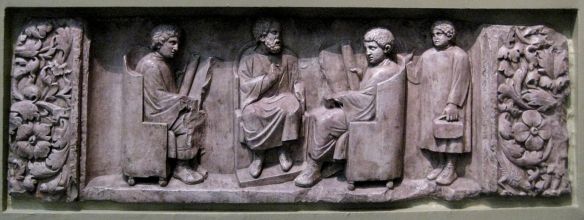
Relief depicting Roman school, found in Roman Neumagen, near Trier, 2nd century CE. Photo credit: Shakko/Wikipedia


Epistle XCIV — On the Value of Advice

Indeed, the persons who  take the greatest pains to proffer such advice are themselves unable to put it into practice. …[I]t is the hottest-tempered school-master who contends that one should never lose one’s temper. Go to any elementary school, and you will learn that just such pronouncements, emanating from high-browed philosophers, are to be found in the lesson-book for boys!

Seneca Epistles 93-124, Translation by Richard Gummere. Loeb Classical Library.

Welcome all deities

Photo: Roman General, 1st century CE, figurine by Young Miniatures.

One unique element in the religion of ancient Rome was its ability to incorporate many different gods and goddesses from the peoples it conquered. One way in which this was done was a ceremony called evocatio, which means “summoning away.” It is described in Religions of Rome, Volume II, by Mary Beard, John North and Simon PriceBefore attacking a town, they write, “The Roman general would offer the enemy god a cult and temple in Rome —so depriving the enemy of their divine protection, while at the same time incorporating a new deity into the Roman pantheon.”

One example of this is found in Livy’s History of Rome, when the general (at this time, a dictator) Marcus Furius Camillus attacked Veii, a major Etruscan city near Rome, in 390 BCE. Livy writes, “After consulting the auspices, the dictator went out and ordered the soldiers to take up arms. ‘It is under your leadership,’ he said, ‘Pythian Apollo, and inspired by your majesty, that I proceed to destroy the city of Veii. And I vow to you a tenth part of the spoils. To you also, Juno Regina, who now lives in Veii, I pray that after our victory you will accompany us to our city —soon to be your city— to be received in a temple worthy of your greatness.'”

How clients are entertained

Mosaic of slaves serving at a banquet, from Carthage, 3rd century CE. Louvre, Paris. Photo by Barbara McManus


Ancient Rome was full of dubious hospitality. The complicated system of patronage meant that clients were occasionally invited to a banquet, in gratitude or reciprocity for all their efforts on their patron’s behalf. It was not uncommon for guests at the same party to be treated to different food and wine, served on different plates and glasses, depending on where they stood in the social hierarchy. J.P.V.D. Balsdon notes in Life and Leisure in Ancient Rome, that “(t)his differentiation, it seems, could be made even between guests at the same table.”

In “How Clients Are Entertained,” Juvenal, taking the part of the client/guest, asks, “[i]s a dinner worth all the insults with which you have to pay for it?”

“First of all be sure of this –that when bidden to dinner, you receive payment in full for all your past services. A meal is the return which your grand friendship yields you; the great man scores it against you…

“The page [slave] who has cost so many thousands cannot mix a drink for a poor man: but then his beauty, his youth, justify his disdain! … It is beneath him to attend to an old dependent; he is indignant that you should ask for anything, and that you should be seated while he stands. All your great houses are full of saucy slaves. See with what a grumble another of them has handed you a bit of hard bread that you can scarce break in two, or bits of solid dough that have turned mouldy – stuff that will exercise your grinders  and into which no tooth can gain admittance. For [the host] himself a delicate loaf is reserved, white as snow, and kneaded of the finest flour. Be sure to keep your hands off it: take no liberties with the bread-basket! …’What?’ you may ask, ‘was it for this that I would so often leave my wife’s side on a spring morning and hurry up the chilly Esquiline when the spring skies were rattling down the pitiless hail, and the rain was pouring in streams off my cloak?’

Juvenal, Satire V, 20-25; 60-70. Loeb edition, translated by G.G. Ramsay