Seneca on Saturday: ancient Roman caution

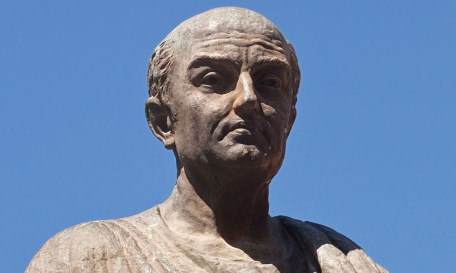
Statue of Lucius Annaeus Seneca the Younger,

Statue of Lucius Annaeus Seneca the Younger in Cordoba, Spain, by Amadeo Ruiz Olmos


Lord Macaulay once said that Seneca the Younger was easily quotable, but reading him straight through would be like “dining on nothing but anchovy sauce.”

I agree! Thus I present some of the condensed wit and wisdom of Seneca, every Saturday.

On Anger

When you are about to rejoice most, you will have most to fear. When everything seems to you to be peaceful, the forces that will harm are not nonexistent, but inactive. Always believe that there will come some blow to strike you.

Moral Essays, Volume I, by Lucius Annaeus Seneca the Younger, translated by John W. Basore. Loeb Library.

Photo credit: Gunnar Bach Pedersen, courtesy Wikimedia Commons.

On courage

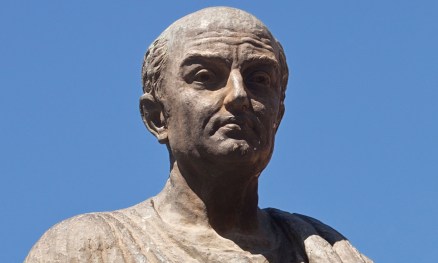
Statue of Lucius Annaeus Seneca the Younger,

Statue of Lucius Annaeus Seneca the Younger in Cordoba, Spain, by Amadeo Ruiz Olmos

Lord Macaulay once said that Seneca the Younger was easily quotable, but reading him straight through would be like “dining on nothing but anchovy sauce.”

I agree! Thus I present some of the condensed wit and wisdom of Seneca, every Saturday.

Letter XXII — On the futility of half-way measures

No man is so faint-hearted that he would rather hang in suspense forever than drop once and for all.


Seneca Epistles 1-65, Translation by Richard Gummere. Loeb Classical Library.

Photo credit: Gunnar Bach Pedersen, courtesy Wikimedia Commons.

Seneca on Saturday — nothing is ours except time

Statue of Lucius Annaeus Seneca the Younger,

Statue of Lucius Annaeus Seneca the Younger in Cordoba, Spain, by Amadeo Ruiz Olmos

Lord Macaulay once said that Seneca the Younger was easily quotable, but reading him straight through would be like “dining on nothing but anchovy sauce.”

I agree! Thus I present some of the condensed wit and wisdom of Seneca, every Saturday.

EPISTLE I. On Saving Time

… Furthermore, if you will pay close heed to the problem, you will find that the largest portion of our life passes while we are doing ill, a goodly share while we are doing nothing, and the whole while we are doing that which is not to the purpose. What man can you show me who places any value on his time, who reckons the worth of each day, who understands that he is dying daily? For we are mistaken when we look forward to death; the major portion of death has already passed. Whatever years lie behind us are in death’s hands.

Therefore, Lucilius, do as you write me that you are doing: hold every hour in your grasp. Lay hold of to-day’s task, and you will not need to depend so much upon to-morrow’s. While we are postponing, life speeds by. Nothing, Lucilius, is ours, except time. We were entrusted by nature with the ownership of this single thing, so fleeting and slippery that anyone who will can oust us from possession. What fools these mortals be! They allow the cheapest and most useless things, which can easily be replaced, to be charged in the reckoning, after they have acquired them; but they never regard themselves as in debt when they have received some of that precious commodity,–time! And yet time is the one loan which even a grateful recipient cannot repay.

Seneca Epistles 1-65, Translation by Richard Gummere. Loeb Classical Library.

Photo credit: Gunnar Bach Pedersen, courtesy Wikimedia Commons.

Seneca on Saturday — hurry up and wait

Statue of Lucius Annaeus Seneca the Younger,

Statue of Lucius Annaeus Seneca the Younger in Cordoba, Spain, by Amadeo Ruiz Olmos

Lord Macaulay once said that Seneca the Younger was easily quotable, but reading him straight through would be like “dining on nothing but anchovy sauce.”

I agree! Thus I present some of the condensed wit and wisdom of Seneca, every Saturday.

Ancient Rome ran on favors. Each man had someone more important than himself to impress, and someone beneath him to bestow favors upon. The patron-client relationship was one of mutual obligation, requiring political loyalty from a client in return for protection, legal assistance and/or financial support from a patron. Clients lined up before dawn in their patron’s courtyard, and were seen — or avoided — according to their status.

Here is Seneca’s description of the tradition of the morning greeting, and how little it profited either the client or the patron:

“Those who rush about in the performance of social duties, who give themselves and others no rest, when they have fully indulged their madness, when they have every day crossed everybody’s threshold, and have left no open door unvisited, when they have carried around their venal greeting to houses that are very far apart – out of a city so huge and torn by such varied desires, how few will they be able to see?  How many will there be who either from sleep or self-indulgence or rudeness will keep them out!  How many who, when they have tortured them with long waiting, will rush by, pretending to be in a hurry!  How many will avoid passing out through a hall that is crowded with clients, and will make their escape through some concealed door as if it were not more discourteous to deceive than to exclude.  How many, still half asleep and sluggish from last night’s debauch, scarcely lifting their lips in the midst of a most insolent yawn, manage to bestow on yonder poor wretches, who break their own slumber in order to wait on that of another, the right name only after it has been whispered to them a thousand times!”

From On the Shortness of Life, by Lucius Annaeus Seneca the Younger,

Translated by John W. Basore, Loeb Classical Library

Seneca on Saturday — fear and hope

Statue of Lucius Annaeus Seneca the Younger,

Statue of Lucius Annaeus Seneca the Younger in Cordoba, Spain, by Amadeo Ruiz Olmos

Lord Macaulay once said that Seneca the Younger was easily quotable, but reading him straight through would be like “dining on nothing but anchovy sauce.” I agree! Thus I present some of the condensed wit and wisdom of Seneca, every Saturday.


EPISTLE  V. The philosopher’s mean, Part II.

Just as the same chain fastens the prisoner and the soldier who guards him, so hope and fear, dissimilar as they are, keep step together; fear follows hope. I am not surprised that they proceed in this way; each alike belongs to a mind that is in suspense, a mind that is fretted by looking forward to the future. But the chief cause of both these ills is that we do not adapt ourselves to the present, but send our thoughts a long way ahead. … The present alone can make no man wretched.

Seneca Epistles 1-65, Translation by Richard Gummere. Loeb Classical Library.

Photo credit: Gunnar Bach Pedersen, courtesy Wikimedia Commons.