Unknown's avatar

About Valerie Block

Novelist and observer of the news, ancient and not

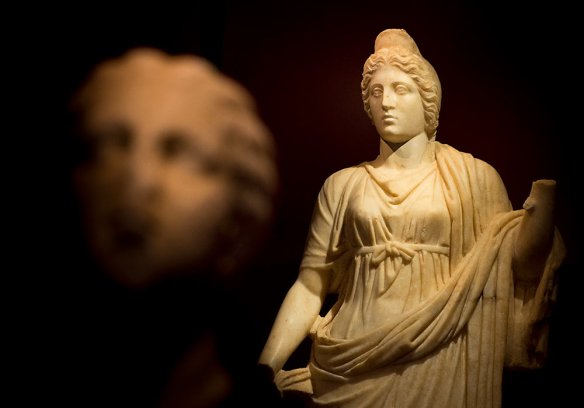
April Deity of the Month: Ceres

1000x700-Halaesa-Ceres-20150315-Halesa-01_1017

Statue of Ceres (2nd century CE) in the museum at Halaesa Arconidea, Sicily.


Ceres was the Roman goddess of agriculture, specifically grain crops. Her parents were Saturn and Ops; she was the mother of Proserpina. Her festival was the Cerialia, held between April 12th and 19th, with games in the Circus Maximus on the final day. One of the rituals associated with these games was the opener: hundreds of foxes with flaming torches tied to their tails ran out onto the track. There was a fast in honor of Ceres on October 4th. She was also given a sacrifice to purify a house after a funeral.

For more concise information on Roman deities and everyday life, consult Handbook to Life in Ancient Rome, by Lesley Adkins and Roy A. Adkins.

Photo: Per-Erik Skramstad / Wonders of Sicily

Seneca on Sunday — on ripe fruit

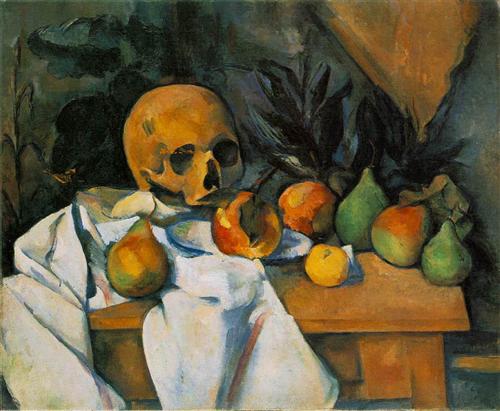
still-life-with-skull-1898.jpg!Blog

Still Life With Skull, by Paul Cezanne. Image courtesy of WikiArt

Epistle XII. On Old Age

Let us cherish and love old age; for it is full of pleasure if one knows how to use it. Fruits are most welcome when almost over; youth is most charming at its close; the last drink delights the toper,– the glass which souses him and puts the finishing touch on his drunkenness. Each pleasure reserves to the end the greatest delights which it contains. Life is most delightful when it is on the downward slope, but has not yet reached the abrupt decline… Or else the very fact of our not wanting pleasures has taken the place the pleasures themselves. How comforting it is to have tired out one’s appetites, and to have done with them! “But,” you say, “it is a nuisance to be looking death in the face!” Death, however, should be looked in the face by young and old alike. We are not summoned according to our rating on the censor’s list. Moreover, no one is so old that it would be improper for him to hope for another day of existence. And one day, mind you, is a stage on life’s journey.

Seneca Epistles 1-65, Translation by Richard Gummere. Loeb Classical Library.

Advice for writers

images

Image from Pixabay.


“If you are a creative worker, remember that time spent in finding an independent technique is seldom wasted. We are accustomed to think of the success of a man like Joseph Conrad, a Pole, in writing the English language, or of the work of an electrical genius like Steinmetz, as savoring of the miraculous. To have had to work out their problems alone — what a tremendous obstacle to overcome! On the contrary; the necessity for independent action was one of the conditions of their success, and to see and admit this is in no way to detract from the worth of their accomplishment.”

— Dorothea Brande, Wake Up and Live!

Wake Up and Live! is an impatient, dyspeptic self-help guide from 1936 on how to overcome the fear of failure. You can skip right past Brande’s descriptions of the many different kinds of failure, and get right to the how to overcome it part. In a nutshell, her slogan is, “Act as if it were impossible to fail.” This is good advice for any enterprise, writing especially.

Good advice can sometimes come from not such great sources: Brande, who also wrote the perennially popular  Becoming a Writer, has recently been outed for elitism, anti-Modernism, anti-Semitism and fascist sympathies. Read this fascinating piece by cultural historian Joanna Scutts about how successful self-help authors, like Brande, Napoleon Hill and Dale Carnegie, “worked to convince readers that they could take power into their own hands, which were not tied by economic circumstances or political realities. That the genre experienced a boom during the politically turbulent 1930s was not a coincidence, but rather a consequence, of that turbulence.” 

And then act as if it were impossible to fail.

Seneca on Saturday: when every new day is a bonus

cb8ebccdaddc699a46e9e6e3ceac9d54a23568ec

Male figure on funerary couch surrounded by funeral cortège (detail), Funerary procession, Amiternum, c. 50-1 B.C.E. (Museum, Aquila) (photo: Erin Taylor, CC BY-NC-ND 2.0)


Epistle XII: On Old Age

Pacuvius… used to hold a regular burial sacrifice in his own honor, with wine and the usual funeral feasting, and then would have himself carried from the dining-room to his chamber, while eunuchs applauded and sang in Greek to a musical accompaniment: “He has lived his life, he has lived his life!” Thus Pacuvius had himself carried out to burial every day. Let us, however, do from a good motive what he used to do from a debased motive; let us go to our sleep with joy and gladness; let us say:

I have lived; the course which Fortune set for me

Is finished.**

And if God is pleased to add another day, we should welcome it with glad hearts. That man is happiest, and is secure in his own possession of himself, who can await the morrow without apprehension. When a man has said: “I have lived!”, every morning he arises is a bonus.

** Vergil, Aenid, iv. 63

Seneca Epistles 1-65, Translation by Richard Gummere. Loeb Classical Library.

Seneca on Saturday — on generosity

Handshake.HiRes.AW

image by Andy Bridge


EPISTLE LXXXI. On Benefits.

You complain that you have met with an ungrateful person. If this is your first experience of that sort, you should offer thanks to your good luck or your caution. In this case, however, caution can effect nothing but to make you ungenerous… It is better… to get no return than to confer no benefits. Even after a poor crop one should sow again… In order to discover one grateful person, it is worth while to make trial of many ungrateful ones.


Seneca Epistles 1-65, Translation by Richard Gummere. Loeb Classical Library.