

The after-life of rock stars
It is impossible to return to the music of one’s youth without considering the rock star’s “after-life,” once the band broke up, or the solo artist no longer commanded the spotlight. Post-hit rock stars intrigue me. How have they aged? How did they handle changes in the business? Did their music change or grow as styles changed? Did they develop themselves as people beyond the limelight? And, special extra credit for artists of the 1980s: how much do they regret their rampant use of synthesizers, such a telltale sign of the age now?

George Harrison, c. 1966

George Harrison, c. 1987.
George Harrison (my first favorite Beatle) had many advantages in his after-life, among them, that he was young, just 27 when his “first” band ended. Not that the break up meant he was out of the spotlight, out of favor or on the skids. Harrison immediately launched a flourishing solo career; he had a stockpile of compositions vetoed by John Lennon and Paul McCartney for Beatles albums, all ready to go. After the Beatles, Harrison played and recorded with many, many other musicians, from Ravi Shankar to Doris Troy. In many ways, Harrison is the ultimate example of how a rock star can make a graceful transition in after-life. In subsequent years, he created the first-ever mega concert fundraiser for a cause, and successfully branched out into music production, film production, humanitarian work, political activism and gardening. And all of this was before the Traveling Wilburys.
To refresh your memory, this was a super-group of rock stars who pooled their collective talent and glamour on an album that became a multi-platinum success in the late 80s. And here’s a news hook: it has been eight years since the Deluxe Second Edition re-release of the 20th Anniversary Box Set of The Traveling Wilburys Collection!
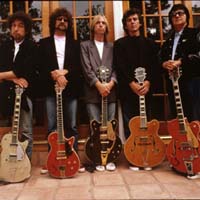
The Traveling Wilburys, 1988.
A super-group is born
According to legend, Harrison had gathered a bunch of friends to knock off a track for the B-side of one of his Cloud Nine singles. His friends happened to be Roy Orbison, Bob Dylan, Tom Petty and Jeff Lynne of ELO. (If you are too young to know what a B-side is, or what ELO was, perhaps these meditations on mortality and time passing will not be so relevant to you.) The resulting song, “Handle With Care,” was too fabulous to waste as a B-side, so Harrison decided to get his friends together again to write a whole album in a friendly, collaborative environment. This all-star group hung out in the kitchen and garden of a borrowed house in Encino, CA; they wrote and recorded a song a day for nine days. All five frontmen wrote, sang, played and produced, apparently without ego issues, resulting in a batch of whimsical, catchy tunes that were released to great enthusiasm at the time. It revived everyone’s careers.
It’s hard to fathom, but by rock-n-roll standards, these guys were old in 1988.

George Harrison, Tom Petty, Jeff Lynne and his hair, 1988
An origins video
That Harrison and Orbison are no longer around makes the “after-life” of the Traveling Wilburys even sadder. But the music still sounds fresh —no rampant use of synthesizers. Check out the relaxed California vibe and exuberant hair of the 1980s in this fun origins-video, courtesy of the official site of the Traveling Wilburys.
Up next in this series: when the music of your youth no longer moves you.




 Valerie Block