Seneca on Saturday — dangerous dinner party

Bust of Gaius Caesar, aka “Caligula,” from the Ny Carlsberg Glyptoteket, Copenhagen.

Lord Macaulay once said that Seneca the Younger was easily quotable, but reading him straight through would be like “dining on nothing but anchovy sauce.”

I agree! Thus I present some of the condensed wit and wisdom of Seneca, every Saturday.

Here is a curious story of survival at Court. Seneca tells this story as an example of the hospitality one could expect from Gaius Caesar, aka “Caligula,” the third Emperor of Rome.


On Anger

Gaius Caesar, offended with the son of Pastor, a distinguished Roman knight, because of his foppishness and his too elaborately dressed hair, sent him to prison; when the father begged that his son’s life might be spared, Caesar, just as if he had been reminded to punish him, ordered him to be executed forthwith; yet in order not to be wholly brutal to the father, he invited him to dine with him that day. Pastor actually came and showed no reproach in his countenance. Caesar, taking a cup, proposed his health and set some one to watch him; the poor wretch went through with it, although he seemed to be drinking the blood of his Son. Caesar then sent him perfume and garlands of flowers and gave orders to watch whether he used them: he used them. On the very day on which he had buried – no, before he had yet buried – his son, he took his place among a hundred dinner-guests, and, old and gouty as he was, drained a draught of wine that would scarce have been a seemly potion even on the birthday of one of his children, all the while shedding not a single tear nor by any sign suffering his grief to be revealed; at the dinner he acted as if he had obtained the pardon he had sought for his son. Do you ask why? He had a second son.

From Lucius Annaeus Seneca the Younnger, Moral Essays, Volume I, translated by John W. Basore. Loeb Classical Library.

March Word of Mouth

810yISJIu8L._SY355_

Music: What It Is: Funky Soul and Rare Grooves (1967-1977), from the Vaults of Atlantic, Atco and Warner Bros. Records. Various artists.

Comedy:  No Can Defend — Gary Gulman

Memoir: Year of YesShonda Rhimes

Writing: The Forest for the Trees: an Editor’s Advice to Writers Betsy Lerner

Essays: 100 Essays I Don’t Have Time To Write: on Umbrellas and Sword Fights, Parades and Dogs, Fire Alarms, Children and Theater — Sarah Ruhl

Movie: Crouching Tiger, Hidden Dragon: Sword of Destiny — Yuen Woo-Ping. Netflix.

Not-So-Ancient Inspiration: “Nothing is so fatiguing as the eternal hanging on of an uncompleted task.” — William James


Seneca on Saturday — conform on the outside

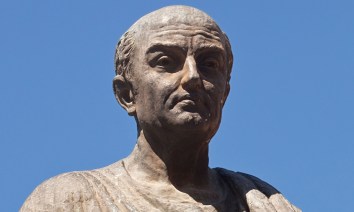
Statue of Lucius Annaeus Seneca the Younger,

Statue of Lucius Annaeus Seneca the Younger in Cordoba, Spain, by Amadeo Ruiz Olmos

Lord Macaulay once said that Seneca the Younger was easily quotable, but reading him straight through would be like “dining on nothing but anchovy sauce.”

I agree! Thus I present some of the condensed wit and wisdom of Seneca, every Saturday.

EPISTLE V. The philosopher’s mean, Part I.

I commend you and rejoice in the fact that you are persistent in your studies, and that, putting all else aside, you make it each day your endeavor to become a better man…. I warn you, however, not to act after the fashion of those who desire to be conspicuous rather than to improve, by doing things which will rouse comment as regards your dress or general way of living. Repellent attire, unkempt hair, slovenly beard, open scorn of silver dishes, a couch on the bare earth, and any other perverted forms of self-display, are to be avoided. The mere name of philosophy, however quietly pursued, is an object of sufficient scorn; and what would happen if we should begin to separate ourselves from the customs of our fellow men? Inwardly, we ought to be different in all respects, but our exterior should conform to society. Do not wear too fine, nor yet to frowzy, a toga. One needs no silver plate, encrusted and embossed in solid gold; but we should not believe the lack of silver and gold to be proof of the simple life. Let us try to maintain a higher standard of life than that of the multitude, but not a contrary standard; otherwise, we shall frighten away and repel the very persons whom we are trying to improve.

Seneca Epistles 1-65, Translation by Richard Gummere. Loeb Classical Library.

Photo credit: Gunnar Bach Pedersen, courtesy Wikimedia Commons.

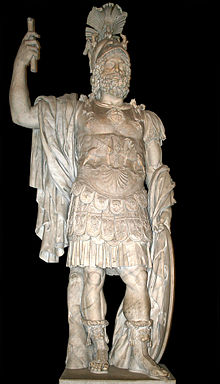
Deity of the Month: MARS

220px-0_Statue_de_Mars_(Pyrrhus)_-_Musei_Capitolini_-_MC0058_(2)

First century statue of Mars at the Musei Capitolini in Rome

Originally an Italian god of agriculture and guardian of fields and boundaries, Mars was later connected to the Greek god of war, Ares. Mars was considered the god of warfare, as opposed to the goddess Minerva, the Roman equivalent of Athena, who was associated with military strategy. And although the Greek god Ares was portrayed as a destructive force, Mars to the Romans represented military power used to achieve stability. A festival celebrating Mars in both his roles, as a war god, and as an agricultural god, ran over three weeks long during the month of March, which was named after him. The festivities included processions of ritual dancing by priestly colleges, sacrifices, horse and chariot racing and purification of the sacred war trumpets and shields. Mars also had a series of festivals in February, May and October to honor him. His union with Rhea Silvia produced Romulus and Remus, the mythical founders of Rome; his union with Venus, the Roman goddess of love, produced the child Cupid. The wolf and the woodpecker were his sacred animals, and he is often portrayed wearing a helmet and carrying a spear.


Seneca on Leap Day — a little throat-cutting during intermission

Statue of Lucius Annaeus Seneca the Younger,

Statue of Lucius Annaeus Seneca the Younger in Cordoba, Spain, by Amadeo Ruiz Olmos

Lord Macaulay once said that Seneca the Younger was easily quotable, but reading him straight through would be like “dining on nothing but anchovy sauce.”

I agree! Thus I present some of the condensed wit and wisdom of Seneca, usually on Saturdays, but today — special! — on a Monday, Leap Day, in honor of changing the schedule in order to get back on track.

EPISTLE VII. On Crowds

But nothing is so damaging to good character as the habit of lounging at the games; for then it is that vice steals subtly upon one though the avenue of pleasure. What do you think I mean? I mean that I come home more greedy, more ambitious, more voluptuous, and even more cruel and inhuman, – because I have been among human beings. By chance I attended a mid-day exhibition, expecting some fun, wit, and relaxation, – an exhibition at which men’s eyes have respite from the slaughter of their fellow-men.

But it was quite the reverse. The previous combats were the essence of compassion; but now all the trifling is put aside and it is pure murder. (*) The men have no defensive armour. They are exposed to blows at all points, and no one ever strikes in vain.

Many persons prefer this programme to the usual pairs… Of course they do; there is no helmet or shield to deflect the weapon. What is the need of defensive armour or of skill? All these mean delaying death. In the morning they throw men to the lions and the bears; at noon, they throw them to the spectators. …

You may retort: “But he was a highway robber; he killed a man!” And what of it? granted that, as a murderer, he deserved his punishment, what crime have you committed, poor fellow, that you should deserve to sit and see this show? …And when the games stop for the intermission, they announce: “A little throat-cutting in the meantime, so that there may still be something going on.

* Translator’s note: During the luncheon interval condemned criminals were often driven into the arena and compelled to fight, for the amusement of those spectators who remained throughout the day.


Seneca Epistles 1-65, Translation by Richard M. Gummere. Loeb Classical Library.

Photo credit: Gunnar Bach Pedersen, courtesy Wikimedia Commons.

Seneca on Saturday — on rising to the occasion

Statue of Lucius Annaeus Seneca the Younger,

Statue of Lucius Annaeus Seneca the Younger in Cordoba, Spain, by Amadeo Ruiz Olmos

Lord Macaulay once said that Seneca the Younger was easily quotable, but reading him straight through would be like “dining on nothing but anchovy sauce.”

I agree! Thus I present some of the condensed wit and wisdom of Seneca, every Saturday.


EPISTLE LXVII — On ill health and endurance of suffering

You say: “If it is a good to be brave under torture, to go to the stake with a stout heart, to endure illness with resignation, it follows that these things are desirable. But I do not see that any of them is worth praying for…”

My dear Lucilius, you must distinguish between these case; you will comprehend that there is something within them to be desired. I should prefer to be free from torture; but if the time comes when it must be endured, I shall desire that I may conduct myself therein with bravery, honor, and courage. Of course I prefer that war should not occur; but if war does occur, I shall desire that I may nobly endure the wounds, the starvation, and all that the exigency of war brings. Nor am I so mad as to crave illness; but if I must suffer illness, I shall desire that I may do nothing which shows lack of restraint, and nothing that is unmanly. The conclusion is, not that hardships are desirable, but that virtue is desirable, which enables us patiently to endure hardships.


Seneca Epistles 66-92, Translation by Richard M. Gummere. Loeb Classical Library.

Photo credit: Gunnar Bach Pedersen, courtesy Wikimedia Commons.