Seneca on Saturday — do as I say

Photo credit: Shakko/Wikipedia

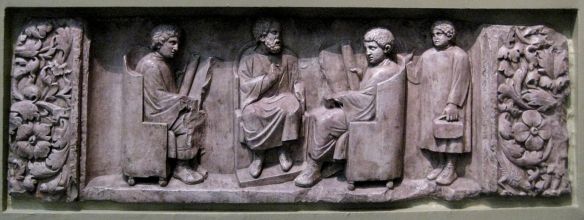
Relief depicting Roman school, found in Roman Neumagen, near Trier, 2nd century CE. Photo credit: Shakko/Wikipedia


Epistle XCIV — On the Value of Advice

Indeed, the persons who  take the greatest pains to proffer such advice are themselves unable to put it into practice. …[I]t is the hottest-tempered school-master who contends that one should never lose one’s temper. Go to any elementary school, and you will learn that just such pronouncements, emanating from high-browed philosophers, are to be found in the lesson-book for boys!

Seneca Epistles 93-124, Translation by Richard Gummere. Loeb Classical Library.

Welcome all deities

Photo: Roman General, 1st century CE, figurine by Young Miniatures.

One unique element in the religion of ancient Rome was its ability to incorporate many different gods and goddesses from the peoples it conquered. One way in which this was done was a ceremony called evocatio, which means “summoning away.” It is described in Religions of Rome, Volume II, by Mary Beard, John North and Simon PriceBefore attacking a town, they write, “The Roman general would offer the enemy god a cult and temple in Rome —so depriving the enemy of their divine protection, while at the same time incorporating a new deity into the Roman pantheon.”

One example of this is found in Livy’s History of Rome, when the general (at this time, a dictator) Marcus Furius Camillus attacked Veii, a major Etruscan city near Rome, in 390 BCE. Livy writes, “After consulting the auspices, the dictator went out and ordered the soldiers to take up arms. ‘It is under your leadership,’ he said, ‘Pythian Apollo, and inspired by your majesty, that I proceed to destroy the city of Veii. And I vow to you a tenth part of the spoils. To you also, Juno Regina, who now lives in Veii, I pray that after our victory you will accompany us to our city —soon to be your city— to be received in a temple worthy of your greatness.'”

How clients are entertained

Mosaic of slaves serving at a banquet, from Carthage, 3rd century CE. Louvre, Paris. Photo by Barbara McManus


Ancient Rome was full of dubious hospitality. The complicated system of patronage meant that clients were occasionally invited to a banquet, in gratitude or reciprocity for all their efforts on their patron’s behalf. It was not uncommon for guests at the same party to be treated to different food and wine, served on different plates and glasses, depending on where they stood in the social hierarchy. J.P.V.D. Balsdon notes in Life and Leisure in Ancient Rome, that “(t)his differentiation, it seems, could be made even between guests at the same table.”

In “How Clients Are Entertained,” Juvenal, taking the part of the client/guest, asks, “[i]s a dinner worth all the insults with which you have to pay for it?”

“First of all be sure of this –that when bidden to dinner, you receive payment in full for all your past services. A meal is the return which your grand friendship yields you; the great man scores it against you…

“The page [slave] who has cost so many thousands cannot mix a drink for a poor man: but then his beauty, his youth, justify his disdain! … It is beneath him to attend to an old dependent; he is indignant that you should ask for anything, and that you should be seated while he stands. All your great houses are full of saucy slaves. See with what a grumble another of them has handed you a bit of hard bread that you can scarce break in two, or bits of solid dough that have turned mouldy – stuff that will exercise your grinders  and into which no tooth can gain admittance. For [the host] himself a delicate loaf is reserved, white as snow, and kneaded of the finest flour. Be sure to keep your hands off it: take no liberties with the bread-basket! …’What?’ you may ask, ‘was it for this that I would so often leave my wife’s side on a spring morning and hurry up the chilly Esquiline when the spring skies were rattling down the pitiless hail, and the rain was pouring in streams off my cloak?’

Juvenal, Satire V, 20-25; 60-70. Loeb edition, translated by G.G. Ramsay


Seneca on Saturday — basic principles vs. special cases

Image of a javelin thrower, among the 3rd century mosaics of athletes found in the Baths of Caracalla, now in the Vatican Museum.

Image of a javelin thrower, among the 3rd century mosaics of athletes found in the Baths of Caracalla, now located in the Vatican Museum.

Epistle XCIV — On the Value of Advice

Just as the the student of javelin-throwing keeps aiming at a fixed target and thus trains the hand to give direction to the missile, and when, by instruction and practice, he has gained the desired ability, he can then employ it against any target he wishes (having learned to strike not at any random object, but precisely the object at which he has aimed), — so he who has equipped himself for the whole of life does not need to be advised concerning each separate item, because he is now trained to meet his problem as a whole; for he knows not merely how he should live with his wife or his son, but how he should live aright. In this knowledge there is also included the proper way of living with wife and children.

Seneca Epistles 93-124, Translation by Richard Gummere. Loeb Classical Library.

What we owe our guests

QPQ

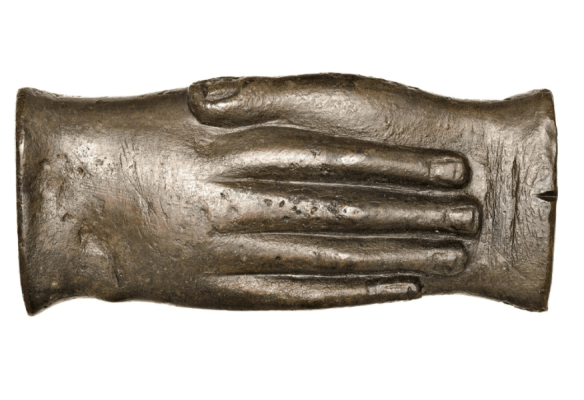
Bronze hospitality tessera, from the 1st century BCE. Found in Castillo de Cedrillas, Teruel, Spain. From the Museo Aqueológico Nacional.

In Latin, the word for guest and host are the same: hospes, reflecting the idea that one should be an excellent host on principle, because one would surely be a guest before long. Reciprocity of this kind played an important role at a time when there were few amenities or services for those in transit, and traveling was a dangerous business. According to A Dictionary of Greek and Roman Antiquities, a connection of private hospitality to a Roman implied a bond more sacred than that which he owed his own blood relations, and required receiving a traveler in his home, offering him protection, and representing him in court, if need be. Once established, these relationships could go on over centuries. A traveler seeking to activate a mutual aid connection would present a hospitality tessera, like the one above, when arriving at someone’s home. This was something between an identity card and a token, to identify the traveler, who might be several generations removed from the host family’s original friend. Sometimes, the tessera was two pieces of a whole, that fit together like a jigsaw puzzle.

Think of a familiar story about strangers from another part of the ancient world: Lot greeted two angels visiting Sodom, offering them hospitality, including a feast and shelter in his home. When the men of Sodom surrounded Lot’s house and demanded that he hand his guests over to them, Lot pleaded, “I beg you, my brothers, do not act so wickedly. Behold, I have two daughters who have not known man; let me bring them out to you, and do to them as you please; only do nothing to these men, for they have come under the shelter of my roof.” — GENESIS 19:1-11.

This puts the occasional house visit (from in-laws, college friends and long-lost acquaintances from the Old Country) into perspective, no?


April Word of Mouth

510c2rxD+9L._SX329_BO1,204,203,200_

Fiction: The Good Thief Hannah Tinti

Non-fiction: Jihad Academy: The Rise of Islamic State  Nicolas Hénin

Memoir: All Who Go Do Not ReturnShulem Deen

History: Caligula: the Corruption of Power — Anthony A. Barrett

Movie: Eye in the Sky — Gavin Hood

TV: The GameToby Whithouse, BBC


Not-So-Ancient Inspiration: “The enemy is a very good teacher.” — the Dalai Lama