Seneca on Saturday — do as I say

Photo credit: Shakko/Wikipedia

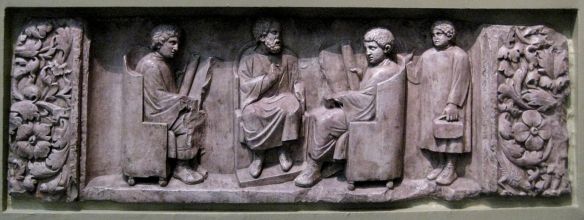
Relief depicting Roman school, found in Roman Neumagen, near Trier, 2nd century CE. Photo credit: Shakko/Wikipedia


Epistle XCIV — On the Value of Advice

Indeed, the persons who  take the greatest pains to proffer such advice are themselves unable to put it into practice. …[I]t is the hottest-tempered school-master who contends that one should never lose one’s temper. Go to any elementary school, and you will learn that just such pronouncements, emanating from high-browed philosophers, are to be found in the lesson-book for boys!

Seneca Epistles 93-124, Translation by Richard Gummere. Loeb Classical Library.

Seneca on Saturday — basic principles vs. special cases

Image of a javelin thrower, among the 3rd century mosaics of athletes found in the Baths of Caracalla, now in the Vatican Museum.

Image of a javelin thrower, among the 3rd century mosaics of athletes found in the Baths of Caracalla, now located in the Vatican Museum.

Epistle XCIV — On the Value of Advice

Just as the the student of javelin-throwing keeps aiming at a fixed target and thus trains the hand to give direction to the missile, and when, by instruction and practice, he has gained the desired ability, he can then employ it against any target he wishes (having learned to strike not at any random object, but precisely the object at which he has aimed), — so he who has equipped himself for the whole of life does not need to be advised concerning each separate item, because he is now trained to meet his problem as a whole; for he knows not merely how he should live with his wife or his son, but how he should live aright. In this knowledge there is also included the proper way of living with wife and children.

Seneca Epistles 93-124, Translation by Richard Gummere. Loeb Classical Library.

Seneca on Saturday — on what we can control

roman_mosaic_boat

Roman mosaic from Zeugitana, Carthage (now Tunisia): Theseus escaping King Minos’ labyrinth, 3rd century CE. From the University of Pennsylvania’s Museum of Anthropology and Archeology


EPISTLE XLVII

Each man acquires his character for himself, but accident assigns his duties.

Seneca Epistles 1-65, Translation by Richard Gummere. Loeb Classical Library.
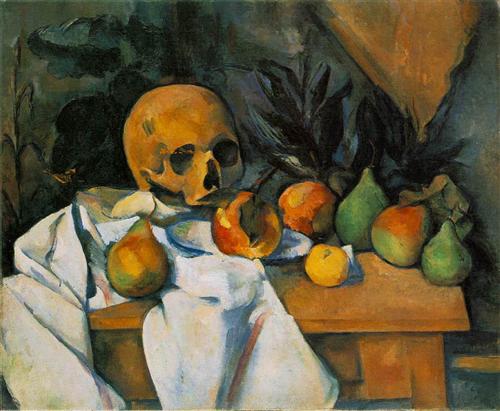
Photo credit: Luke Jones at flickr.

Seneca on Sunday — on ripe fruit

still-life-with-skull-1898.jpg!Blog

Still Life With Skull, by Paul Cezanne. Image courtesy of WikiArt

Epistle XII. On Old Age

Let us cherish and love old age; for it is full of pleasure if one knows how to use it. Fruits are most welcome when almost over; youth is most charming at its close; the last drink delights the toper,– the glass which souses him and puts the finishing touch on his drunkenness. Each pleasure reserves to the end the greatest delights which it contains. Life is most delightful when it is on the downward slope, but has not yet reached the abrupt decline… Or else the very fact of our not wanting pleasures has taken the place the pleasures themselves. How comforting it is to have tired out one’s appetites, and to have done with them! “But,” you say, “it is a nuisance to be looking death in the face!” Death, however, should be looked in the face by young and old alike. We are not summoned according to our rating on the censor’s list. Moreover, no one is so old that it would be improper for him to hope for another day of existence. And one day, mind you, is a stage on life’s journey.

Seneca Epistles 1-65, Translation by Richard Gummere. Loeb Classical Library.

Seneca on Saturday: when every new day is a bonus

cb8ebccdaddc699a46e9e6e3ceac9d54a23568ec

Male figure on funerary couch surrounded by funeral cortège (detail), Funerary procession, Amiternum, c. 50-1 B.C.E. (Museum, Aquila) (photo: Erin Taylor, CC BY-NC-ND 2.0)


Epistle XII: On Old Age

Pacuvius… used to hold a regular burial sacrifice in his own honor, with wine and the usual funeral feasting, and then would have himself carried from the dining-room to his chamber, while eunuchs applauded and sang in Greek to a musical accompaniment: “He has lived his life, he has lived his life!” Thus Pacuvius had himself carried out to burial every day. Let us, however, do from a good motive what he used to do from a debased motive; let us go to our sleep with joy and gladness; let us say:

I have lived; the course which Fortune set for me

Is finished.**

And if God is pleased to add another day, we should welcome it with glad hearts. That man is happiest, and is secure in his own possession of himself, who can await the morrow without apprehension. When a man has said: “I have lived!”, every morning he arises is a bonus.

** Vergil, Aenid, iv. 63

Seneca Epistles 1-65, Translation by Richard Gummere. Loeb Classical Library.

Seneca on Saturday — on generosity

Handshake.HiRes.AW

image by Andy Bridge


EPISTLE LXXXI. On Benefits.

You complain that you have met with an ungrateful person. If this is your first experience of that sort, you should offer thanks to your good luck or your caution. In this case, however, caution can effect nothing but to make you ungenerous… It is better… to get no return than to confer no benefits. Even after a poor crop one should sow again… In order to discover one grateful person, it is worth while to make trial of many ungrateful ones.


Seneca Epistles 1-65, Translation by Richard Gummere. Loeb Classical Library.