IDEA: “A person who claims to be religious, but finds a way to justify the abduction of a 5-year-old child, is a heretic, a danger to America, and an embarrassment to his faith.” from the sermon “We are under-reacting,” by Rabbi Sharon Brous, of IKAR
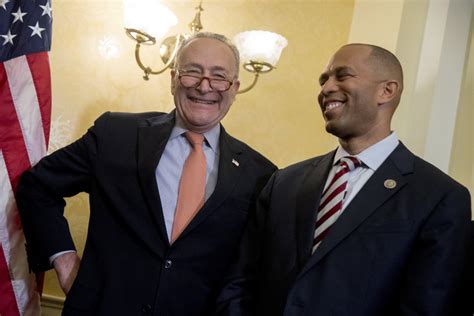
Senate Minority Leader Chuck Schumer, and House Minority Leader Hakeem Jeffries. Andrew Harnik/AP Photo
ENGAGE:
Come On!:Democrats: This Is War: Isn’t It About Time You Started Acting Like It? — Michael Tomasky. “No, Democrats. No sitting around and waiting for things to change. Help make them change. Public opinion will shift more quickly if you kindle that shift… Democrats rarely try to force a change in the way voters see an issue. They rarely play the role of disruptors. Well, folks, if ever history was grabbing you by the lapels and demanding that you do some disrupting, it’s now. And if the hearts and minds of the working class constitute the main front in our political battle, how about a weekly press conference by Democrats ticking off the ways in which the administration has made things worse for working-class people? Trump has stripped the National Labor Relations board of a quorum, meaning that it can’t defend workers’ rights. People don’t care? Nonsense. Choose a couple emotionally charged examples that will make them care.”
Fear, Chaos and Capture:Trump’s American Takeover —Amicus Podcast, with Dahlia Lithwick, an interview with Kim Lane Scheppele, Trump’s moves follow the authoritarian playbook in Hungary, Russia, Venezuela, in which an authoritarian is democratically elected, changes the constitution, and then cancels all legal precedents. “It’s important to keep toeholds that you can use to leverage into more power for the opposition… civil sector groups, state governments in blue states, anything that has not yet been captured… we should lean into the parts of the government that are not gonna go down without a fight…. look at where public outrage can at least gum up the works. Everything that this administration does now that is bringing down democracy and causing pain should be met with friction. You may not be able to stop it, but you can slow it down.”
Scapegoats:Trump’s Boogeyman: D.E.I.— The New Yorker Radio Hour Podcast. David Remnick interviews Jelani Cobb, Dean of Columbia School of Journalism, who says: “Morale is not great [among journalists]. We should never allow young or emerging journalists to have the idea that there’s a one to one relationship between our effort and the outcome…. We don’t know what the ratio is — it’s unknowable, unpredictable, completely random. And my version of encouragement has been that we keep doing the work until we get to that breakthrough moment where it actually really, really does make a difference.”
Move Fast and Break Things.How WIRED Magazine is Scooping the Competition, plus Whither the Democrats? On the Media Podcast. Brook Gladstone interviews Ezra Levin, of Indivisible, on Congressional Democrats’ “Stop the Steal” bill: “Nobody with even a passing understanding or familiarity with how Congress works, believes this bill is ever gonna get a vote; nobody believes if this bill got a vote that it would pass; nobody believes that if it passed that Donald Trump would sign it; nobody believes that if he vetoed it that Congress would override it; and nobody believes that if Congress even succeeded in overriding it, that Trump would agree to implement it. What this bill does is say, ‘I’m Chuck Schumer, I’m Hakeem Jeffries: I care.’ I don’t care that you care; I care that you’re using the power available to you.” Indivisible suggests using Mitch McConnell’s playbook to push back.
If you have the stomach to think about what is happening, read on. If you’d rather skip the news, and immerse yourself in something else, skip ahead to the ESCAPE section.
Podcast: On the Media: Wars are Won By Stories — Brooke Gladstone interviews Elyse Graham, author of Book and Dagger – How Scholars and Librarians Became the Unlikely Spies of World War Two
With police forces in between, pro-Palestinian and pro-Israeli protesters stand across the street from one another in Montclair, New Jersey. Photo by Shayna Rudoren
Say it loud and say it clear, the guy in the black hoodie began. We don’t want no Zionists here! He punched his fist in the air as the crowd joined in. We don’t want no Zionists here! We don’t want no Zionists here! We don’t want no Zionists here!
Welcome to Montclair, New Jersey, circa 2024. A New York suburb of 40,000 known for its racial diversity, liberal politics, magnet schools, impossible real estate prices (and taxes), panoply of restaurants, annual film festival, frequent Yacht Rock concerts and, now, hate speech. Stephen Colbert’s hometown, and mine. …
I know a lot of my Jewish neighbors, the folks that were on an adjacent corner with Israeli flags and signs like “Denying Jewish history and our connection to Israel is an act of hate,” heard the “No Zionists here” chant as equivalent to “No Jews.” They rightfully point out that it’s impossible to imagine a similar scenario in Montclair targeting any other religious or ethnic group. …
And whichever definition [of Zionism] you choose, whichever group you target, I’m going to be uncomfortable with people chanting that they should not be allowed in my hometown.
Which, I should be clear, does not mean those people should not be allowed to chant it. I believe one of the proudest moments in our history was a Jewish ACLU lawyer defending neo-Nazis’ right to march in Skokie. If the Montclair City Council added a Palestinian flag under the Israeli and Ukrainian ones on our flagpole on Church Street, I’d be fine with it.
It’s important not to get distracted by one particular video you might see and to focus attention on the core demands of this movement. … The core of this movement is the demand to end university and American governmental complicity with Israel’s system of oppression, which is now culminated in this horrifying slaughter of people in Gaza.
This complicity must end. It must end because, among other things, it puts Jews in danger. We must see the lie that you can construct a system of Jewish safety on the destruction and brutalization of another people. We should recognize that October the 7th is just a taste of the horrors that will come to everybody if this system of oppression is deepened and entrenched. Because a system of violence breeds violence. That does not excuse Hamas from its moral responsibility for the horrors of October 7th, not for a second. That’s why I said it’s critical that we promote the idea, that we argue for a movement that makes the distinction between ethical and unethical resistance.
Student protesters: I admire your empathy for Gazans, your concern for the world, your moral ambition to make a difference.
But I worry about how peaceful protests have tipped into occupations of buildings, risks to commencements and what I see as undue tolerance of antisemitism, chaos, vandalism and extremism. I’m afraid the more aggressive actions may be hurting the Gazans you are trying to help.
I’m shaped in my thinking by the Vietnam War protests of the 1960s. Students who protested then were right on the merits: The war was unwinnable and conducted in ways that were reckless and immoral.
Yet those students didn’t shorten that terrible war; instead, they probably prolonged it. Leftist activists in 1968 didn’t achieve their goal of electing the peace candidate Gene McCarthy; rather, the turmoil and more violent protests helped elect Richard Nixon, who pledged to restore order — and then dragged the war out and expanded it to Cambodia.
I think that history is worth remembering today. Good intentions are not enough. Empathy is not enough. I’m sure we all agree that it’s outcomes that matter. So the question I would ask you to ask yourselves is: Are your encampments and sacrifices — more than 1,000 protesters have been arrested so far, and unknown numbers have been suspended or expelled — actually helping Gazans?
I’ve been strongly criticizing Israel’s conduct in Gaza since last fall, and President Biden’s unconditional support for the war. So while my heart’s with the cause, it seems to me that the campus upheavals have distracted from the crisis in Gaza, rather than called attention to it. …
Protest itself is a good thing: Students can write letters to the editor, circulate petitions, hold peaceful rallies and call their members of Congress (or flood the comments section of this column!). I’m all for demanding more humanitarian aid to Gaza and a suspension of transfers of offensive weapons to Israel until it adheres to humanitarian law, plus a major push for a Palestinian state.
Finally, let me offer two concrete suggestions for how we can meaningfully help Palestinians that don’t involve occupying campuses, getting kicked out of college and risking the prolongation of the war.
First, raise funds for organizations actively helping Gazans, like Save the Children, Gisha or International Rescue Committee. That may seem discouragingly modest but it will help real people in desperate need.
Second, this may sound zany, but how about raising money to send as many of your student leaders as possible this summer to live in the West Bank and learn from Palestinians there (while engaging with Israelis on the way in or out)? West Bank monitors say that a recent Israeli crackdown on foreigners helping Palestinians, by denying entry or deporting people, has made this more difficult but not impossible.
Student visitors must be prudent and cautious but could study Arabic, teach English and volunteer with human rights organizations on the ground. Palestinians in parts of the West Bank are under siege, periodically attacked by settlers and in need of observers and advocates.
Those students returning at the end of the summer would have a much deeper understanding of the issues and how to help. It would be life-changing, an education as rich as any you’re getting on campus.


 Valerie Block