Seneca on Saturday — basic principles vs. special cases

Image of a javelin thrower, among the 3rd century mosaics of athletes found in the Baths of Caracalla, now in the Vatican Museum.

Image of a javelin thrower, among the 3rd century mosaics of athletes found in the Baths of Caracalla, now located in the Vatican Museum.

Epistle XCIV — On the Value of Advice

Just as the the student of javelin-throwing keeps aiming at a fixed target and thus trains the hand to give direction to the missile, and when, by instruction and practice, he has gained the desired ability, he can then employ it against any target he wishes (having learned to strike not at any random object, but precisely the object at which he has aimed), — so he who has equipped himself for the whole of life does not need to be advised concerning each separate item, because he is now trained to meet his problem as a whole; for he knows not merely how he should live with his wife or his son, but how he should live aright. In this knowledge there is also included the proper way of living with wife and children.

Seneca Epistles 93-124, Translation by Richard Gummere. Loeb Classical Library.

What we owe our guests

QPQ

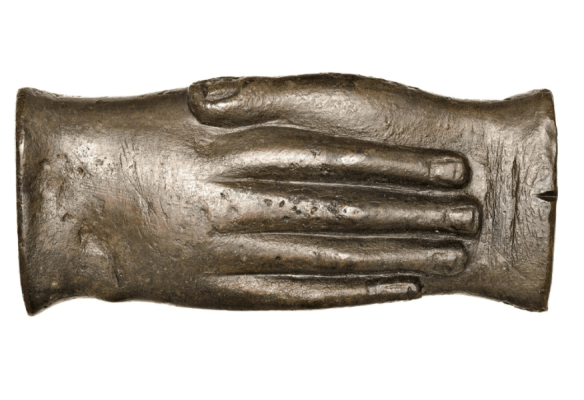
Bronze hospitality tessera, from the 1st century BCE. Found in Castillo de Cedrillas, Teruel, Spain. From the Museo Aqueológico Nacional.

In Latin, the word for guest and host are the same: hospes, reflecting the idea that one should be an excellent host on principle, because one would surely be a guest before long. Reciprocity of this kind played an important role at a time when there were few amenities or services for those in transit, and traveling was a dangerous business. According to A Dictionary of Greek and Roman Antiquities, a connection of private hospitality to a Roman implied a bond more sacred than that which he owed his own blood relations, and required receiving a traveler in his home, offering him protection, and representing him in court, if need be. Once established, these relationships could go on over centuries. A traveler seeking to activate a mutual aid connection would present a hospitality tessera, like the one above, when arriving at someone’s home. This was something between an identity card and a token, to identify the traveler, who might be several generations removed from the host family’s original friend. Sometimes, the tessera was two pieces of a whole, that fit together like a jigsaw puzzle.

Think of a familiar story about strangers from another part of the ancient world: Lot greeted two angels visiting Sodom, offering them hospitality, including a feast and shelter in his home. When the men of Sodom surrounded Lot’s house and demanded that he hand his guests over to them, Lot pleaded, “I beg you, my brothers, do not act so wickedly. Behold, I have two daughters who have not known man; let me bring them out to you, and do to them as you please; only do nothing to these men, for they have come under the shelter of my roof.” — GENESIS 19:1-11.

This puts the occasional house visit (from in-laws, college friends and long-lost acquaintances from the Old Country) into perspective, no?


April Word of Mouth

510c2rxD+9L._SX329_BO1,204,203,200_

Fiction: The Good Thief Hannah Tinti

Non-fiction: Jihad Academy: The Rise of Islamic State  Nicolas Hénin

Memoir: All Who Go Do Not ReturnShulem Deen

History: Caligula: the Corruption of Power — Anthony A. Barrett

Movie: Eye in the Sky — Gavin Hood

TV: The GameToby Whithouse, BBC


Not-So-Ancient Inspiration: “The enemy is a very good teacher.” — the Dalai Lama


Seneca on Saturday — on what we can control

roman_mosaic_boat

Roman mosaic from Zeugitana, Carthage (now Tunisia): Theseus escaping King Minos’ labyrinth, 3rd century CE. From the University of Pennsylvania’s Museum of Anthropology and Archeology


EPISTLE XLVII

Each man acquires his character for himself, but accident assigns his duties.

Seneca Epistles 1-65, Translation by Richard Gummere. Loeb Classical Library.

Photo credit: Luke Jones at flickr.

April Deity of the Month: Ceres

1000x700-Halaesa-Ceres-20150315-Halesa-01_1017

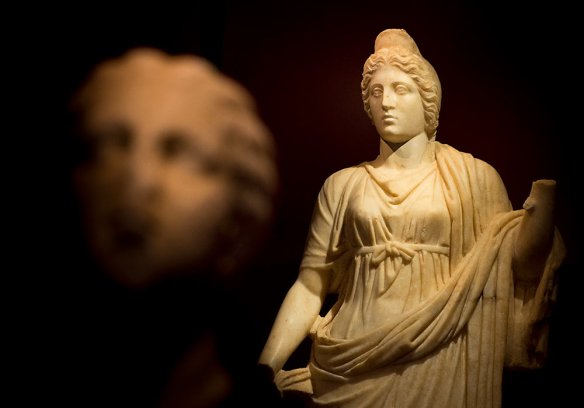
Statue of Ceres (2nd century CE) in the museum at Halaesa Arconidea, Sicily.


Ceres was the Roman goddess of agriculture, specifically grain crops. Her parents were Saturn and Ops; she was the mother of Proserpina. Her festival was the Cerialia, held between April 12th and 19th, with games in the Circus Maximus on the final day. One of the rituals associated with these games was the opener: hundreds of foxes with flaming torches tied to their tails ran out onto the track. There was a fast in honor of Ceres on October 4th. She was also given a sacrifice to purify a house after a funeral.

For more concise information on Roman deities and everyday life, consult Handbook to Life in Ancient Rome, by Lesley Adkins and Roy A. Adkins.

Photo: Per-Erik Skramstad / Wonders of Sicily

Seneca on Sunday — on ripe fruit

still-life-with-skull-1898.jpg!Blog

Still Life With Skull, by Paul Cezanne. Image courtesy of WikiArt

Epistle XII. On Old Age

Let us cherish and love old age; for it is full of pleasure if one knows how to use it. Fruits are most welcome when almost over; youth is most charming at its close; the last drink delights the toper,– the glass which souses him and puts the finishing touch on his drunkenness. Each pleasure reserves to the end the greatest delights which it contains. Life is most delightful when it is on the downward slope, but has not yet reached the abrupt decline… Or else the very fact of our not wanting pleasures has taken the place the pleasures themselves. How comforting it is to have tired out one’s appetites, and to have done with them! “But,” you say, “it is a nuisance to be looking death in the face!” Death, however, should be looked in the face by young and old alike. We are not summoned according to our rating on the censor’s list. Moreover, no one is so old that it would be improper for him to hope for another day of existence. And one day, mind you, is a stage on life’s journey.

Seneca Epistles 1-65, Translation by Richard Gummere. Loeb Classical Library.