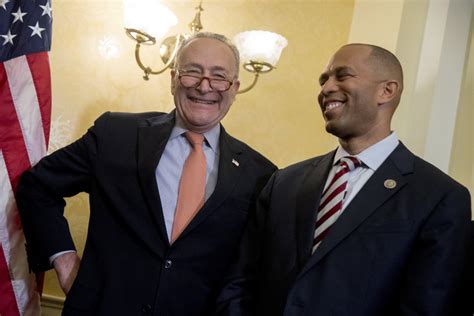
Senate Minority Leader Chuck Schumer, and House Minority Leader Hakeem Jeffries. Andrew Harnik/AP Photo
ENGAGE:
Come On!:Democrats: This Is War: Isn’t It About Time You Started Acting Like It? — Michael Tomasky. “No, Democrats. No sitting around and waiting for things to change. Help make them change. Public opinion will shift more quickly if you kindle that shift… Democrats rarely try to force a change in the way voters see an issue. They rarely play the role of disruptors. Well, folks, if ever history was grabbing you by the lapels and demanding that you do some disrupting, it’s now. And if the hearts and minds of the working class constitute the main front in our political battle, how about a weekly press conference by Democrats ticking off the ways in which the administration has made things worse for working-class people? Trump has stripped the National Labor Relations board of a quorum, meaning that it can’t defend workers’ rights. People don’t care? Nonsense. Choose a couple emotionally charged examples that will make them care.”
Fear, Chaos and Capture:Trump’s American Takeover —Amicus Podcast, with Dahlia Lithwick, an interview with Kim Lane Scheppele, Trump’s moves follow the authoritarian playbook in Hungary, Russia, Venezuela, in which an authoritarian is democratically elected, changes the constitution, and then cancels all legal precedents. “It’s important to keep toeholds that you can use to leverage into more power for the opposition… civil sector groups, state governments in blue states, anything that has not yet been captured… we should lean into the parts of the government that are not gonna go down without a fight…. look at where public outrage can at least gum up the works. Everything that this administration does now that is bringing down democracy and causing pain should be met with friction. You may not be able to stop it, but you can slow it down.”
Scapegoats:Trump’s Boogeyman: D.E.I.— The New Yorker Radio Hour Podcast. David Remnick interviews Jelani Cobb, Dean of Columbia School of Journalism, who says: “Morale is not great [among journalists]. We should never allow young or emerging journalists to have the idea that there’s a one to one relationship between our effort and the outcome…. We don’t know what the ratio is — it’s unknowable, unpredictable, completely random. And my version of encouragement has been that we keep doing the work until we get to that breakthrough moment where it actually really, really does make a difference.”
Move Fast and Break Things.How WIRED Magazine is Scooping the Competition, plus Whither the Democrats? On the Media Podcast. Brook Gladstone interviews Ezra Levin, of Indivisible, on Congressional Democrats’ “Stop the Steal” bill: “Nobody with even a passing understanding or familiarity with how Congress works, believes this bill is ever gonna get a vote; nobody believes if this bill got a vote that it would pass; nobody believes that if it passed that Donald Trump would sign it; nobody believes that if he vetoed it that Congress would override it; and nobody believes that if Congress even succeeded in overriding it, that Trump would agree to implement it. What this bill does is say, ‘I’m Chuck Schumer, I’m Hakeem Jeffries: I care.’ I don’t care that you care; I care that you’re using the power available to you.” Indivisible suggests using Mitch McConnell’s playbook to push back.
If you have the stomach to think about what is happening, read on. If you’d rather skip the news, and immerse yourself in something else, skip ahead to the ESCAPE section.
Podcast: On the Media: Wars are Won By Stories — Brooke Gladstone interviews Elyse Graham, author of Book and Dagger – How Scholars and Librarians Became the Unlikely Spies of World War Two
Idea: “Dobbs was never self-limiting to abortion—it was a save-the-date card for the religious right’s plan to come for the rest of our reproductive freedoms. …
This is the two-step wherein the state forces women to have babies they cannot raise, does nothing to help support them, then swoops in to seize the babies when their parents are seen as endangering them—a phenomenon that of course predominantly hurts poor women and women of color. The state also ensures that adoptions flow in the direction of more “worthy” parents, which means heterosexual and Christian parents, a regime also built into the legal framework. The list of people who cannot assert autonomy and control over their potential children has, in the course of a few weeks, now expanded from LGBTQ+ parents, single parents, poor parents, and parents of color to anyone who has started the process of IVF in Alabama.” —The IVF Ruling Is About Who Gets to Raise Your Children— Dahlia Lithwick in SLATE.



 Valerie Block