Unknown's avatar

About Valerie Block

Novelist and observer of the news, ancient and not

Seneca on Saturday: fair-weather friends

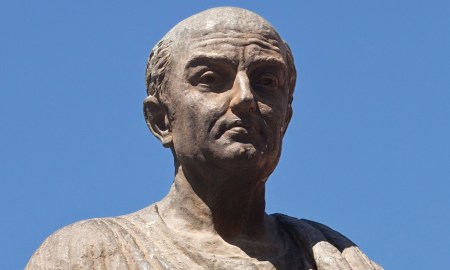
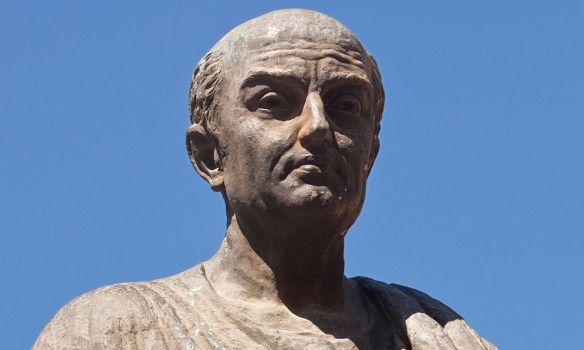
Statue of Lucius Annaeus Seneca the Younger,

Statue of Lucius Annaeus Seneca the Younger in Cordoba, Spain, by Amadeo Ruiz Olmos

IX: On Philosophy and Friendship

These are the so-called “fair-weather” friendships; one who is chosen for the sake of utility will be satisfactory only so long as he is useful. Hence prosperous men are blockaded by troops of friends; but those who have failed stand amid vast loneliness, their friends fleeing from the very crisis which is to test their worth. Hence, also, we notice those many shameful cases of persons who, through fear, desert or betray. The beginning and the end cannot but harmonize. He who begins to be your friend because it pays will also cease because it pays.

Seneca Epistles 1-65, by Lucius Annaeus Seneca the Younger. Translation by Richard Gummere. Loeb Classical Library.


Late September Word of Mouth


Song: Turntables [Emotion Picture] — Janelle Monáe

Documentary: All in: The Fight for Democracy — Liz Garbus and Lisa Cortes

Memoir: My Time Among the Whites — Jennine Capót Crucet

Mystery: Who Is Vera Kelly? — Rosalie Knecht

TV Series: Taste the Nation — Padma Lakshmi


Word of Mouth, Quarantine Edition

Prior to the advent of Covid-19, I was about 70% through the first draft of a novel about a virus, an anger virus. Looking back on what I wrote, I am stunned by how mild and self-contained the virus I created was. I am currently too busy  panic cleaning, home schooling and hand washing to do much about the novel, but in the process of doing research into epidemiology and vaccines, I came across several books that helped me understand how viruses work, and thought now would be an excellent time to recommend them.

If you have it in you to learn more about how microscopic pathogens can upend the globe, here are four fascinating books that helped me understand. If you’ve had enough pathogens, skip ahead to the ESCAPE section. And wash your hands!

ENGAGE:

Memoir about a pandemic (small pox) with a happy ending: Sometimes Brilliant:The Impossible Adventure of a Spiritual Seeker and Visionary Physician Who Helped Conquer the Worst Disease in History, by Larry Brilliant

Thematic treatment of how pathogens develop and mutate, and what is necessary for them to thrive: Pandemic: Tracking Contagions, From Cholera to Ebola and Beyond, by Sonia Shah

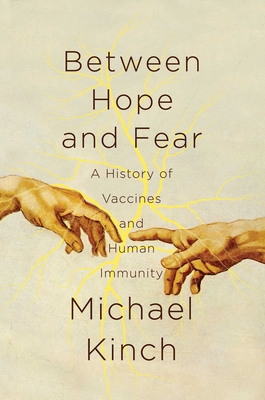
A history of how vaccines were discovered, and how they work: Between Hope and Fear: A History of Vaccines and Human Immunity, by Michael Kinch

How cholera seized and changed London, seen through the efforts of a pioneering physician and a connected local priest: The Ghost Map: The Story of London’s Most Terrifying Epidemic–and How It Changed Science, Cities, and the Modern World— Steven Johnson

ESCAPE:

TV: Agents of ShieldMaurissa Tancharoen, Jed Whedon, Joss Whedon. Netflix

TV: Episodes — David Crane and Jeffrey Klarik. Amazon. 

TV: False Flag — Maria Feldman, Amit Cohen. Hulu.

TV: Imposters – Paul Adelstein and Adam Brooks. Netflix. 

MOVIE: Yesterday –Danny Boyle. HBO.

TV: MarpleAgatha Christie. Hulu.

FICTION: The Safety Net — Andrea Camilleri

Not-so-ancient wisdom:

“It’s not enough that we do our best; sometimes we have to do what is required.”

Winston Churchill

January Word of Mouth

Fiction: To Each His Own — Leonardo Sciascia, translated by Adrienne Foulke.

Memoir: Born a Crime — Trevor Noah.

Podcast episode: “An Historical Lens on Trump’s Authoritarianism.” Trumpcast. 

Non-Fiction: The Saboteur: The Aristocrat Who Became France’s Most Daring Anti-Nazi Commando — Paul Kix.

Documentary with Animation: Ask Dr. Ruth — Ryan White. Hulu. 

Stand-Up Comedy: “Ronny Chieng: Asian Comedian Destroys America!” Netflix.

Not-so-ancient wisdom: “There is little hope for us until we become tough-minded enough to break loose from the shackles of prejudice, half-truths, and downright ignorance. The shape of the world today does not permit us the luxury of soft-mindedness. A nation or a civilization that continues to produce soft-minded men purchases its own spiritual death on an installment plan.”

         — Martin Luther King, Jr., “Strength To Love”


Seneca on Saturday: On the provocations of vice

Dionysius (the Roman god Bacchus) riding on the back of a lion, accompanied by satyrs. Ancient Roman mosaic, 2nd-3rd century CE. El Djem Museum, Tunisia. Image from Theoi Greek Mythology. 

XLI: On Baiae and morals

“Just as I do not care to live in a place of torture, neither do I care to live in a café. To witness persons wandering drunk along the beach, the riotous revelling of sailing parties, the lakes a-din with choral song, and all the other ways in which luxury, when it is, so to speak, released from the restraints of law not merely sins, but blazons its sins abroad, — why must I witness this? We ought to see to it that we flee to the greatest possible distance from provocations to vice. We should toughen our minds, and remove them far from the allurements of pleasure. A single winter relaxed Hannibal’s fibre; his pampering in Campania took the vigour out of that hero who had triumphed over Alpine snows. He conquered with his weapons, but was conquered with his vices.” 

Seneca Epistles 1-65, by Lucius Annaeus Seneca the Younger. Translation by Richard Gummere. Loeb Classical Library.


Seneca on Saturday (on Tuesday)

A cast of the tombstone of the centurion M Favonius Facilis from Colchester, United Kingdom, 43-50 CE.

XLIX: On the shortness of life

“Why do you torment yourself and lose weight over some problem which it is more clever t o have scorned than to solve? When a soldier is undisturbed and traveling at his ease, he can hunt for trifles along his way; but when the enemy is closing in on the rear, and a command is given to quicken the pace, necessity makes him throw away everything which he picked up in moments of peace and leisure. I have no time to investigate disputed inflections of words, or to try my cunning upon them.” 

Seneca Epistles 1-65, by Lucius Annaeus Seneca the Younger. Translation by Richard Gummere. Loeb Classical Library.


Photo by Brownie Bear on flickr·