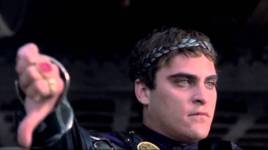
The Emperor inflates his charisma

maxresdefaultimages

“The survival of an autocracy depends on the visible exercise of power by the autocrat himself; a democracy may be run by an abstract administrative entity (though even here figureheads are required), but an autocrat has to be seen to be actively in charge. Hence it is particularly important for him to embody the authority of the supreme purveyor of justice. A correlation has been made between the increasingly harsh penalties under the Empire and the absolutist trend in Roman government; so too the emperor is free to devise ingenious methods of ridding his empire of undesirable elements, inflating his charisma by the reincarnation of myth.”

From “Fatal Charades: Roman Executions Staged as Mythological Enactments,” by K.M. Coleman. In the Journal of Roman Studies, Volume 80, 1990.

July Word of Mouth

cover170x170

Music: Guilt By Association Volume IV: 1966 — Various artists


Creativity: The Path of Least Resistance — Robert Fritz


TV: Grantchester — Daisy Coulam


Not-So-Ancient Inspiration: “The ultimate weakness of violence is that it is a descending spiral, begetting the very thing it seeks to destroy. Instead of diminishing evil, it multiplies it. Through violence you may murder the liar, but you cannot murder the lie, nor establish the truth. Through violence you may murder the hater, but you do not murder hate. In fact, violence merely increases hate. So it goes. Returning violence for violence multiplies violence, adding deeper darkness to a night already devoid of stars. Darkness cannot drive out darkness: only light can do that. Hate cannot drive out hate: only love can do that.”

Martin Luther King, Jr., from Where Do We Go From Here: Chaos or Community?, with thanks to Rene for the reference.


June Word of Mouth

61dyGz7sCWL._SX404_BO1,204,203,200_


Children’s Picture Book: Mr. Particular — Jason Kirschner

Fiction: Red April — Santiago Roncagliolo

Memoir: The Bridge Ladies — Betsy Lerner

Documentary: My Italian Secret — Oren Jacoby

TV: Occupied — Karianne Lund,  Jo Nesbø,  Erik Skjoldbjærg. Netflix.

Writing: The Clockwork Muse — Eviator Zerubavel

Not-So-Ancient Inspiration: “The bad thing about all religions is that, instead of being able to confess their allegorical nature, they have to conceal it; accordingly, they parade their doctrines in all seriousness as true sensu proprio, and as absurdities form an essential part of these doctrines we have the great mischief of a continual fraud. Nay, what is worse, the day arrives when they are no longer true sensu proprio, and then there is an end of them; so that, in that respect, it would be better to admit their allegorical nature at once. But the difficulty is to teach the multitude that something can be both true and untrue at the same time. Since all religions are in a greater or less degree of this nature, we must recognise the fact that mankind cannot get on without a certain amount of absurdity, that absurdity is an element in its existence, and illusion indispensable; as indeed other aspects of life testify.”

Arthur Schopenhauer, from “The Christian System” in Religion: A Dialogue, and Other Essays, (1910) as translated by Thomas Bailey Saunders, p. 106.

Method and Motivation: the moral of the story

horses-1348284_960_720


As a thinking person, I really do dislike being manipulated by stories. It’s one of my main beefs against Disney. As a mother on stage at bedtime, however, I frequently find myself violating all my own higher standards of storytelling. Like many parents, I am exhausted, impatient and creatively challenged at bedtime, so if I do take the time to create a story, I fling myself onto that moral like a life raft. It just comes out of me, and I am appalled at myself.

I created a whole series of tales featuring Shasta, a young pony with a knack for getting into trouble. The jewel in the crown of this franchise was “Baby Pony Shas and the Unexpected Ring of Fire,” which tells how Baby Pony Shas was playing in the living room one morning when his mother was on the phone, for work, in the kitchen. Suddenly, the intoxicating smell of wood smoke beckoned him and, despite his mother’s warning to stay inside and to not –under any circumstances!– open the door or leave the house, Baby Pony Shas found himself doing just that, and following the lovely smell down streets lined with beautiful trees turning amazing shades of orange, yellow and red, to Mountainside Park, where there was a bonfire going, which felt really nice in the cool October air, and then suddenly, suddenly! Baby Pony Shas was surrounded by a ring of flames leaping ten feet high!

I will not insult you by giving you the moral of that story. (But it ends with Baby Pony Shas safely at home, deeply penitent.) As a writer, as a reader, I have nothing but disdain for manipulation and formulas. But as a parent, I need all the help I can get. What about you? Do you tell your own stories with morals, or gravitate to “The Boy Who Cried Wolf ” at bedtime?

 

May Word of Mouth

51BHKP2JW4L._SX312_BO1,204,203,200_

Cultural Analysis: La Bella Figura: A Field Guide to the Italian Mind — Beppe Severgnini

Fiction: Dear Committee Members — Julie Schumacher

Non-fiction: How To Age (The School of Life) — Anne Karpf

Documentary: When Two Worlds Collide — Heidi Brandenburg and Matthew Orzel

Movie: Sing Street — John Carney

Music: Bonfires on the Heath — the Clientele.

Not-So-Ancient Inspiration: “If you never encounter anything in your community that offends you, then you are not living in a free society.” — Kim Campbell

April Word of Mouth

510c2rxD+9L._SX329_BO1,204,203,200_

Fiction: The Good Thief — Hannah Tinti

Non-fiction: Jihad Academy: The Rise of Islamic State — Nicolas Hénin

Memoir: All Who Go Do Not Return — Shulem Deen

History: Caligula: the Corruption of Power — Anthony A. Barrett

Movie: Eye in the Sky — Gavin Hood

TV: The Game — Toby Whithouse, BBC


Not-So-Ancient Inspiration: “The enemy is a very good teacher.” — the Dalai Lama