Freedom and despair

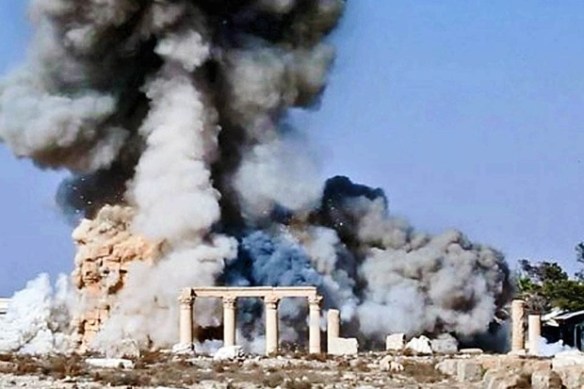
Ancient ruins destroyed by fundamentalists

ISIS blows up ancient Roman ruins at Palmyra, in August, 2015. Photo credit: the Times of London.

At a moment when fear might cloud better judgment, here are some lucid thoughts on fundamentalism. They come from Steven Pressfield’s wonderful treatise on creativity, The War of Art.

Fundamentalism is the philosophy of the powerless, the conquered, the displaced and the dispossessed. Its spawning ground is the wreckage of political and military defeat, as Hebrew fundamentalism arose during the Babylonian captivity, as white Christian fundamentalism appeared in the American South during Reconstruction, as the notion of the Master Race evolved in Germany following World War I. In such desperate times, the vanquished race would perish without a doctrine that restored hope and pride. Islamic fundamentalism ascends from the same landscape of despair and possesses the same tremendous and potent appeal.

What exactly is this despair? It is the despair of freedom. The dislocation and emasculation experienced by the individual cut free from the familiar and comforting structures of the tribe and the clan, the village and the family.

It is the state of modern life.

The fundamentalism (or, more accurately, the beleaguered individual who comes to embrace fundamentalism) cannot stand freedom. He cannot find his way into the future, so he retreats to the past. He returns in imagination to the glory days of his race and seeks to reconstitute both them and himself in their purer, more virtuous light. He gets back to basics. To fundamentals.

Fundamentalism and art are mutually exclusive. There is no such thing as fundamentalist art. This does not mean that the fundamentalist is not creative. Rather, his creativity is inverted. He creates destruction. Even the structures he builds, his schools and networks of organization, are dedicated to annihilation, of his enemies and of himself.

But the fundamentalist reserves his greatest creativity for the fashioning of Satan, the image of his foe, in opposition to which he defines and gives meaning to his own life. Like the artist, the fundamentalist experiences Resistance. He experiences it as temptation to sin. Resistance to the fundamentalist is the call of the Evil One, seeking to seduce him from his virtue.

It may be that the human race is not ready for freedom…. The paradox seems to be, as Socrates demonstrated long ago, that the truly free individual is free only the extent of his own self-mastery. While those who will not govern themselves are condemned to find masters to govern over them.


Seneca on Saturday — Holidays haven’t changed much

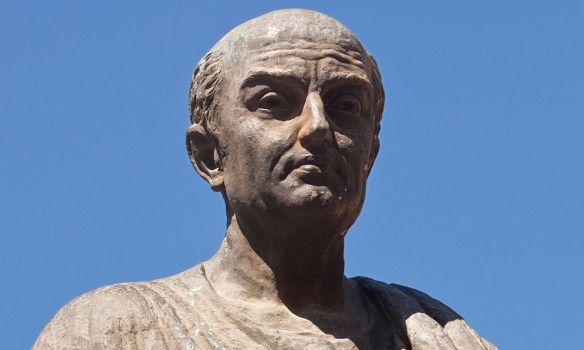
Statue of Lucius Annaeus Seneca the Younger,

Statue of Lucius Annaeus Seneca the Younger in Cordoba, Spain, by Amadeo Ruiz Olmos

Lord Macaulay once said that Seneca the Younger was easily quotable, but reading him straight through would be like “dining on nothing but anchovy sauce.” I agree! Thus I present some of the condensed wit and wisdom of Seneca, every Saturday.


***

From Epistle XVIII, On Festivals and Fasting

It is the month of December, and yet the city is at this very moment in a sweat. License is given to the general merrymaking. Everything resounds with mighty preparations, — as if the Saturnalia differed at all from the usual business day! So true is it that the difference is nil, that I regard as correct the remark of the man who said: “Once December was a month; now it is a year.”

… the surest proof which a man can get of his own constancy [is] if he neither seeks the things which are seductive and allure him to luxury, nor is led into them. It shows much more courage to remain dry and sober when the mob is drunk and vomiting; but it shows greater self-control to refuse to withdraw oneself and to do what the crowd does, but in a different way, — thus neither making oneself conspicuous nor becoming one of the crowd. For one may keep holiday without extravagance.”

Seneca Epistles 1-65, Translation by Richard Gummere. Loeb Classical Library.

Photo credit: Gunnar Bach Pedersen, courtesy Wikimedia Commons.

Seneca on Saturday — over- and under-sharing

Statue of Lucius Annaeus Seneca the Younger,

Statue of Lucius Annaeus Seneca the Younger in Cordoba, Spain, by Amadeo Ruiz Olmos

Lord Macaulay once said that Seneca the Younger was easily quotable, but reading him straight through would be like “dining on nothing but anchovy sauce.” I agree! Thus I present some of the condensed wit and wisdom of Seneca, every Saturday.

***

EPISTLE III. On True and False Friendship

You have sent a letter to me through the hand of a “friend” of yours, as you call him. And in your very next sentence you warn me not to discuss with him all the matters that concern you, saying that even you yourself are not accustomed to do this; in other words, you have in the same letter affirmed and denied that he is your friend. Now if you used this word of ours in the popular sense, and called him “friend” in the same way in which we speak of all candidates for election as “honourable gentlemen,” and as we greet all men whom we meet casually, if their names slip us for the moment, with the salutation “my dear sir,” – so be it. But if you consider any man a friend whom you do not trust as you trust yourself, you are mightily mistaken and you do not sufficiently understand what true friendship means….

Ponder for a long time whether you shall admit a given person to your friendship; but when you have decided to admit him, welcome him with all your heart and soul. …Regard him as loyal, and you will make him loyal. …

There is a class of men who communicate, to anyone whom they meet, matters which should be revealed to friends alone, and unload upon the chance listener whatever irks them. Others, again, fear to confide in their closest intimates; and if it were possible, they would not trust even themselves, burying their secrets deep in their hearts. But we should do neither. …

In like manner you should rebuke these two kinds of men, – both those who always lack repose, and those who are always in repose. For love of bustle is not industry, – it is only the restlessness of a hunted mind. And true repose does not consist in condemning all motion as merely vexation; that kind of repose is slackness and inertia.

Seneca Epistles 1-65, Translation by Richard Gummere. Loeb Classical Library.

Photo credit: Gunnar Bach Pedersen, courtesy Wikimedia Commons.

Music and nostalgia, Part I

The after-life of rock stars

It is impossible to return to the music of one’s youth without considering the rock star’s “after-life,” once the band broke up, or the solo artist no longer commanded the spotlight. Post-hit rock stars intrigue me. How have they aged? How did they handle changes in the business? Did their music change or grow as styles changed? Did they develop themselves as people beyond the limelight? And, special extra credit for artists of the 1980s: how much do they regret their rampant use of synthesizers, such a telltale sign of the age now?

George Harrison, 1966

George Harrison, c. 1966

creem1

George Harrison, c. 1987.


George Harrison (my first favorite Beatle) had many advantages in his after-life, among them, that he was young, just 27 when his “first” band ended. Not that the break up meant he was out of the spotlight, out of favor or on the skids. Harrison immediately launched a flourishing solo career; he had a stockpile of compositions vetoed by John Lennon and Paul McCartney for Beatles albums, all ready to go. After the Beatles, Harrison played and recorded with many, many other musicians, from Ravi Shankar to Doris Troy. In many ways, Harrison is the ultimate example of how a rock star can make a graceful transition in after-life. In subsequent years, he created the first-ever mega concert fundraiser for a cause, and successfully branched out into music production, film production, humanitarian work, political activism and gardening. And all of this was before the Traveling Wilburys.

To refresh your memory, this was a super-group of rock stars who pooled their collective talent and glamour on an album that became a multi-platinum success in the late 80s. And here’s a news hook: it has been eight years since the Deluxe Second Edition re-release of the 20th Anniversary Box Set of The Traveling Wilburys Collection!

13_200

The Traveling Wilburys, 1988.


A super-group is born

According to legend, Harrison had gathered a bunch of friends to knock off a track for the B-side of one of his Cloud Nine singles. His friends happened to be Roy Orbison, Bob Dylan, Tom Petty and Jeff Lynne of ELO. (If you are too young to know what a B-side is, or what ELO was, perhaps these meditations on mortality and time passing will not be so relevant to you.) The resulting song, “Handle With Care,” was too fabulous to waste as a B-side, so Harrison decided to get his friends together again to write a whole album in a friendly, collaborative environment. This all-star group hung out in the kitchen and garden of a borrowed house in Encino, CA; they wrote and recorded a song a day for nine days. All five frontmen wrote, sang, played and produced, apparently without ego issues, resulting in a batch of whimsical, catchy tunes that were released to great enthusiasm at the time. It revived everyone’s careers.

It’s hard to fathom, but by rock-n-roll standards, these guys were old in 1988.

6_200

George Harrison, Tom Petty, Jeff Lynne and his hair, 1988


An origins video

That Harrison and Orbison are no longer around makes the “after-life” of the Traveling Wilburys even sadder. But the music still sounds fresh —no rampant use of synthesizers. Check out the relaxed California vibe and exuberant hair of the 1980s in this fun origins-video, courtesy of the official site of the Traveling Wilburys.

Up next in this series: when the music of your youth no longer moves you.

From 21st century comedy to ancient historical bloodletting

The excavations were empty on the sweltering afternoon in July my husband and I visited Herculaneum. Just a stray dog, a bride and groom posing for photos in front of arches, a caretaker of the ruins, and us.

Herculaneum, photo courtesy of yourbesttravel.com

Herculaneum, photo courtesy of yourbesttravel.com

Archeologist Andrew Wallace-Hadrill, director of the Herculaneum Conservation Project, has written that because of the position of the two towns in relation to the volcano Vesuvius, “[t]he freak chance that Pompeii was blanketed in ash and pumice pebbles, while Herculaneum was covered in the fine, hot dust of pyroclastic surges and flows, resulted in the extensive preservation at Herculaneum of organic material —principally wood, but also foodstuffs, papyrus and cloth.” He adds that the depth of volcanic material that covered Herculaneum was three or four times greater than that of Pompeii, thus preserving some buildings several storeys above street level. Some buildings are so well-preserved, in fact, you might forget you are in an excavation.

Did I mention it was hot? At 5:30, the heat was pulsating off the 2,000-year-old paving stones as I crossed from a fully-intact ancient apartment block to some shade in front of a bakery on the other side of the street. I suddenly had the feeling that I was living there.

I don’t believe in past lives

I don’t mean that I had a memory of a past life in ancient Rome —I don’t believe in past lives. I mean that I felt like I was living in Herculaneum now, on my way from my apartment to the bakery, naturally seeking shade as I walked down the street. It was an odd feeling, and I dismissed it.

But a few days later, in the basement of the Palazzo dei Conservatori in Rome, I was hit with another odd sensation. The epigraphic gallery is a long space lined with tombstones and echoing with the voices of bored teenagers. The epitaphs were helpfully translated from Latin into English: “For the souls departed. May trickery and fraud stay away from this funerary monument,” and “I wish that the earth does not weigh heavily upon your remains.” I was struck by the names (Crustuminius!) the pompous language (“employed as the keeper of the storerooms of the Green Faction”), the colorful variety of professions (“Domitia, maker and seller of scented oils”) and the sad accounting of time (“H, who lived 32 years, 5 months, 21 days, his brother Heres saw to the making of this tomb”). As I passed from one tombstone to the next, the voices in the gallery got louder, and it felt like the ancient people represented were jockeying for my interest, calling out, “Hey: Pay attention to me! This was my life.”
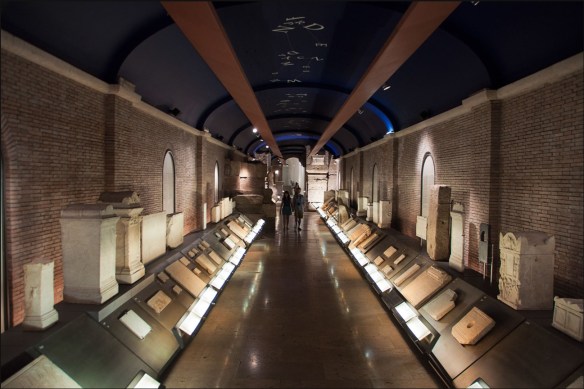
The Epigraphic gallery at the Palazzo dei Conservatoreii, Rome. Photo courtesy of Chris Oler, via Pinterest

The Epigraphic gallery at the Palazzo dei Conservatori, Rome. Photo courtesy of Chris Oler, via Pinterest


A story begins to brew

I returned home with a story brewing, a story about power, status and expectations; it was ancient Rome, so of course there were two feuding brothers. For some reason, I knew that the story had to be told in documents that I would create —letters, invitations, menus, petitions to the Emperor, etc. I have no idea why I was so sure about that, but there is so much self-doubt when writing a novel, if you have absolute certainty about anything, you have to just run with it. I had written three novels of contemporary comic fiction. This leap into ancient historical bloodletting was daring and new, and for a while I sped along, soaking up facts in books, museums and papyri, enthralled by the mysteries of ancient life.

I’ve always been fascinated and repulsed by ancient Rome in equal measure. The Romans were arrogant, brutal, greedy, ostentatious and corrupt. Roman citizens were protected by the rule of law, but those in power routinely disregarded the law with impunity. The Roman aristocracy was ferociously proud of its independence, yet permitted itself to be stripped of all authority by a series of dictators and emperors. Roman engineering was legendarily meticulous, yet the Roman legions demolished the works of others with wanton disrespect. The society was drenched in status anxiety; even among slaves there was a class hierarchy. Ancient Roman culture spanned the heights of rationality and the depths of cruelty. I was riveted.

Rome was not built in a day

Then, like Wiley Coyote, who continues to run in mid-air, crashing only once he notices that he has left the cliff, I saw the gulf between me and everything I didn’t know, panicked, and dropped straight down. The combination of new genre, new format and the imperative of historical accuracy weighed heavily on me. I told myself: Whatever you don’t know, you’ll learn. Rome wasn’t built in a day, and look: it took hundreds of years to destroy! 

On the other hand, enough already: I have been finishing this book for far too long. I am pleased to FINALLY announce that the book that began as an odd feeling in front of a bakery in Herculaneum (I won’t say how many years ago) is now fully cooked. I’ll be taking it out into the world shortly. Stay tuned.

December Word of Mouth

51pEthQ5mUL._SX329_BO1,204,203,200_

Fiction: Americanah, by Chimamanda Ngozi Adichie

Memoir: Whipping Boy: the Forty-Year Search for My Twelve-Year-Old Bully, by Allen Kurzweil

Non-fiction: The Obstacle Is the Way, by Ryan Holiday

History: Working IX to V: Orgy Planners, Funeral Clowns, and other Prized Professions in the Ancient World, by Vicky León

Music: People Gonna Talk, James Hunter

TV: Catastrophe, Ben Taylor, Amazon Video

Movie: The Trip to Italy, Michael Winterbottom

Ancient Inspiration: “The authority of those who teach is often an obstacle to those who want to learn.”  Marcus Tullius Cicero