

Seneca on Saturday — on effective punishment

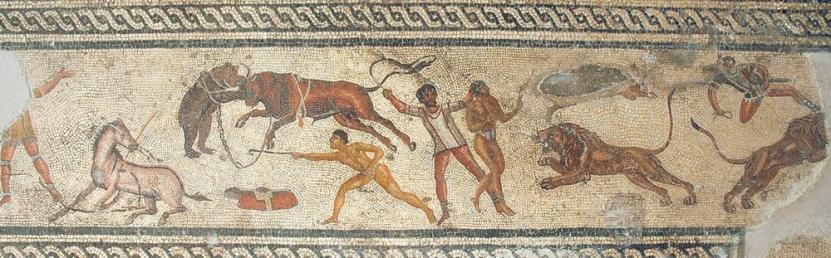
Amphitheater Mosaic, from Villa di Dar Buc Amméra at Zliten, in the Archaeological Museum of Tripoli.

Gladiator Mosaic, from Villa di Dar Buc Amméra at Zliten, in the Archaeological Museum of Tripoli. Photo from Livius.org.

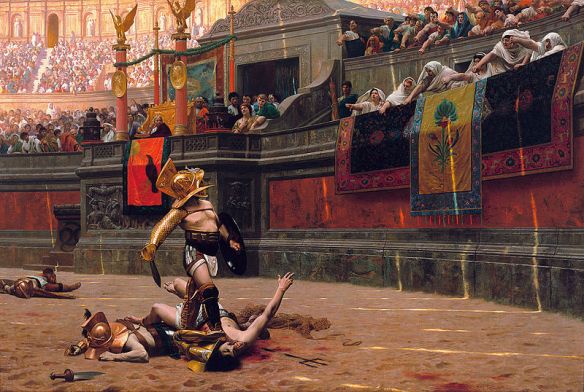
Severity is the best corrective, but loses its efficacy by over-use.

On Clemency. From Seneca’s Moral Essays. Translated by John W. Basore. The Loeb Classical Library. London: W. Heinemann, 1928-1935. 3 vols.: Volume I.

July Word of Mouth

cover170x170

Music: Guilt By Association Volume IV: 1966 — Various artists


Creativity: The Path of Least Resistance — Robert Fritz


TV: Grantchester — Daisy Coulam


Not-So-Ancient Inspiration: “The ultimate weakness of violence is that it is a descending spiral, begetting the very thing it seeks to destroy. Instead of diminishing evil, it multiplies it. Through violence you may murder the liar, but you cannot murder the lie, nor establish the truth. Through violence you may murder the hater, but you do not murder hate. In fact, violence merely increases hate. So it goes. Returning violence for violence multiplies violence, adding deeper darkness to a night already devoid of stars. Darkness cannot drive out darkness: only light can do that. Hate cannot drive out hate: only love can do that.”

Martin Luther King, Jr., from Where Do We Go From Here: Chaos or Community?, with thanks to Rene for the reference.


Deity of the month: Neptune

350px-Sousse_neptune

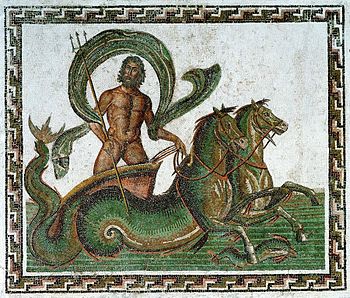
Mosaic of Neptune in his sea-horse drawn chariot, mid 3rd century CE, from the Sousse Archeological Museum, Tunisia.


The management of water was critical in the heat of July, and was dependent on Neptune,   the Roman god of fresh water and the seas, who also protected drilling operations and wells. Neptune was identified with the Greek god Poseidon, and following the Greek tradition, his brothers were Jupiter and Pluto. He was often depicted with horses. A major festival, the Neptunalia, was held in his honor on July 23rd.  According to the 5th century writer Ambrosius Theodosius Macrobius, Neptune was one of only three deities to whom it was appropriate to sacrifice a bull. The other two were Apollo and Mars.

Adapted from Handbook to Life in Ancient Rome, by Lesley Adkins and Roy A. Adkins, and The Gods of Ancient Rome, by Robert Turcan.

Seneca on Saturday — life is like a bathing establishment

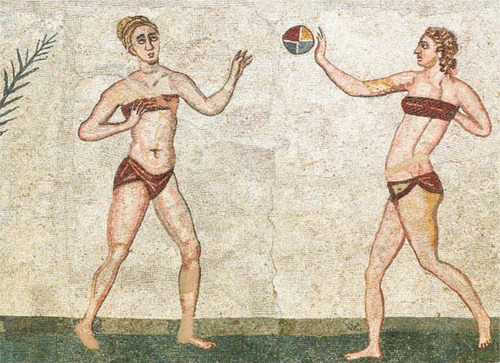
Mosaic from Villa Casale, Piazza Armerina, Sicily, 3rd century. Image from Greek and Roman Mosaics,

Women playing ball. Mosaic from the Villa Romana del Casale, in Piazza Armerina, Sicily, 4th century CE. Image from Greek and Roman Mosaics, by Umberto Pappalardo and Rosario Ciardello.


CVII. On obedience to the universal will

Where is that common sense of yours? …Have you come to be tormented by a trifle?… None of these things is unusual or unexpected. It is as nonsensical to be put out by such events as it is to complain of being spattered in the street or at getting befouled in the mud. The program of life is the same as that of a bathing establishment, a crowd, or a journey: sometimes things will be thrown at you, and sometimes they will strike you by accident. Life is not a dainty business. You have started on a long journey; you are bound to slip, collide, fall, become weary, and cry out: “O for Death!” –or in other words, tell lies. At one stage you will leave a comrade behind you, at another you will bury someone, at another you will be apprehensive. It is amid stumbling of this sort that you must travel out this rugged journey.

Seneca Epistles 93-124, Translation by Richard Gummere. Loeb Classical Library.

Seneca on Saturday — busy? not really

Mosaic from the Villa dei Casale, Piazza Armerina, Sicily. 3-4th century CE.

Mosaic from the Villa Romana del Casale, Piazza Armerina, Sicily. 4th century CE.

CVI. — On the Corporeality of Virtue

My tardiness is answering your letter was not due to press of business. Do not listen to that sort of excuse; I am at liberty, and so is anyone else who wishes to be at liberty. No man is at the mercy of affairs. He gets entangled in them of his own accord, and then flatters himself that being busy is a proof of happiness.

Seneca Epistles 93-124, Translation by Richard Gummere. Loeb Classical Library.

Sulpicia: indiscretion has its charms

Roman fresco (c. 53-79 CE) of a young woman with stylus and wax tablets, from the National Archaeological Museum of Naples. Found in Pompeii.

Roman fresco (c. 53-79 CE) from the National Archaeological Museum of Naples. Found in Pompeii. Probably not the poet Sulpicia, but an ancient woman with a writing implement, nonetheless.

Many women wrote poetry in ancient Rome, but the works of only one have survived. Six short poems written by Sulpicia, the daughter of the jurist and orator Servius Sulpicius Rufus, and the niece of the statesman and patron of the arts Valerius Messalla Corvinus, have survived, handed down as part of the Corpus Tibullianum, a collection of poems by Tibullus and other poets affiliated with Messalla. Sulpicia lived during the time of Augustus.

The above description adapted from Diatoma and The Handbook to life in Ancient Rome, by Lesley Adkins and Roy A. Adkins.

1.

At last. It’s come. Love,
the kind that veiling
will give me reputation more
than showing my soul naked to someone.
I prayed to Aphrodite in Latin, in poems;
she brought him, snuggled him
into my bosom.
Venus has kept her promises:
let her tell the story of my happiness,
in case some woman will be said
not to have had her share.
I would not want to trust
anything to tablets, signed and sealed,
so no one reads me
before my love–
but indiscretion has its charms;
it’s boring
to fit one’s face to reputation.
May I be said to be
a worthy lover for a worthy love.

From Sulpicia: Six Poems. Translation copyright Lee Pearcy; all rights reserved.