Like a politician whose “views have evolved over the years,” my feelings about disco have undergone a transformation. The rallying cry of my adolescent cohort was DEATH BEFORE DISCO. Our obsession was hard driving, often British rock. A new release from Joe Jackson, Elvis Costello, the Police, the Clash, or the Talking Heads meant sitting on the floor for repeated listenings, immersing oneself in the record jacket (often black or florescent pink or green), memorizing the lyrics (often cynical), discovering who played bass (why on earth did I care who played bass?). We listened to this music as if our lives depended on it; we defended this music as if it were under attack. Other rock and pop —the Stones, Steely Dan, Linda Ronstadt— was practically in the water supply, and didn’t require one to actively seek it out or pledge allegiance to it.
Joe Jackson Band, Beat Crazy, 1980
But the soundtrack of the time, keeping everybody’s booty shaking, was the pulsating glitter of disco —tacky, vulgar and unavoidable since Saturday Night Fever, a movie whose preening, strutting misogyny made a deep and unwanted impression on me.
The thinking teenage feminist’s logical antidote
DEATH BEFORE DISCO was the only appropriate response to the heaving, ecstatic moans of Donna Summer (Love to Love You, Baby), Diana Ross (Love Hangover) and Thelma Houston (Don’t Leave Me This Way). All these masochistic divas gyrating their pelvises and moaning about “love” was part of my problem with disco. The implicit idea that one was at the disco itself looking for sex was another issue. Looking back on it, the New Wave aesthetic —angry, angular and cerebral— was the thinking teenage feminist’s logical antidote to the mindless orgy at the disco.
Donna Summer, in her heyday, dressed to moan
Many years, many pounds later: I have discovered that disco is an excellent motivator at the gym. Mind you, I don’t want to listen to it unless I’m suited up in lycra and strapped to a piece of equipment, when the mindless repetition of the music (Shake Shake Shake, More More More, Boogie Oogie Oogie) actually helps with the mindless repetition of the body on the machine, and drowns out whatever thumping techno yowling is currently pelting the gym. There is no better soundtrack to the skating machine than Keep It Coming, Love (KC and the Sunshine Band),Shake Your Groove Thing (Peaches and Herb), or More Than a Woman (the BeeGees), the very music I once disdained so strenuously.In fact, as tawdry as I found disco culture at the time, the music itself, and even the swaggering that surrounds it, retains an odd sweetness lo these many years later. The youthful bounce found especially at the intersection of disco and soul (e.g., Al Green, Barry White, Marvin Gaye, the Jackson 5) is very helpful when one has to kick one’s own ass around the gym. Here’s a great collection, if you need one. And check out To Disco, With Love, a kind of yearbook featuring all the ridiculous and over the top record jackets, recently published.
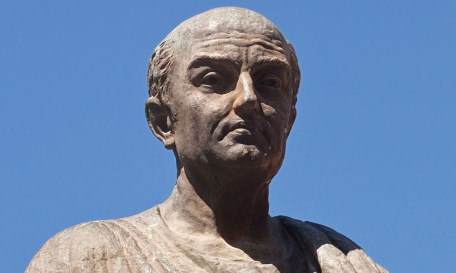
Statue of Lucius Annaeus Seneca the Younger in Cordoba, Spain, by Amadeo Ruiz Olmos
Lord Macaulay once said that Seneca the Younger was easily quotable, but reading him straight through would be like “dining on nothing but anchovy sauce.”
I agree! Thus I present some of the condensed wit and wisdom of Seneca, every Saturday.
On Anger
When you are about to rejoice most, you will have most to fear. When everything seems to you to be peaceful, the forces that will harm are not nonexistent, but inactive. Always believe that there will come some blow to strike you.
Moral Essays, Volume I, by Lucius Annaeus Seneca the Younger, translated by John W. Basore. Loeb Library.
Photo credit: Gunnar Bach Pedersen, courtesy Wikimedia Commons.
The goddess Fornax was in charge of preventing grain from burning in ovens. The festival of Fornacalia was held in her honor in early February, sometime around February 17. The grain was first dried in ovens before being ground in mills for flour. During the Fornacalia, a sacrifice was made in front of the oven, before families shared a communal meal with their neighbors in front of a communal hearth.
The mosaic above is part of a floor of 40 panels with scenes depicting the agricultural calendar. It was found in the archaeological site at Saint-Romain-en-Gal, France, and dates from the early 3rd century CE; it is now located in the Musée d’Archéologie Nationale in Saint-Gemain-en-Laye, just outside of Paris.
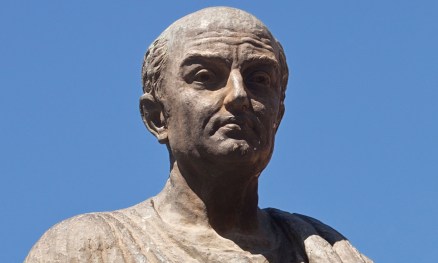
Statue of Lucius Annaeus Seneca the Younger in Cordoba, Spain, by Amadeo Ruiz Olmos
Lord Macaulay once said that Seneca the Younger was easily quotable, but reading him straight through would be like “dining on nothing but anchovy sauce.”
I agree! Thus I present some of the condensed wit and wisdom of Seneca, every Saturday.
Letter XXII — On the futility of half-way measures
No man is so faint-hearted that he would rather hang in suspense forever than drop once and for all.
Seneca Epistles 1-65, Translation by Richard Gummere. Loeb Classical Library.
Photo credit: Gunnar Bach Pedersen, courtesy Wikimedia Commons.
Statue of Lucius Annaeus Seneca the Younger in Cordoba, Spain, by Amadeo Ruiz Olmos
Lord Macaulay once said that Seneca the Younger was easily quotable, but reading him straight through would be like “dining on nothing but anchovy sauce.” I agree! Thus I present some of the condensed wit and wisdom of Seneca, every Saturday.
Select one thought for the day
The primary indication, to my thinking, of a well-ordered mind is a man’s ability to remain in one place and linger in his own company. Be careful, however, lest this reading of many authors and books of every sort may tend to make you discursive and unsteady. You must linger among a limited number of master-thinkers, and digest their works, if you would derive ideas which shall win firm hold in your mind. Everywhere means nowhere. When a person spends all his time in foreign travel, he ends by having many acquaintances, but no friends. And the same must hold true for men who seek intimate acquaintance with no single author, but visit them all in a hasty and hurried manner. …
Accordingly, since you cannot read all the books which you may possess, it is enough to possess only as many books as you can read. … Each day acquire something that will fortify you against poverty, against death, indeed against other misfortunes as well; and after you have run over many thoughts, select one to be thoroughly digested that day. This is my own custom; from the many things which I have read, I claim some one part for myself.




 Valerie Block