Seneca on Leap Day — a little throat-cutting during intermission

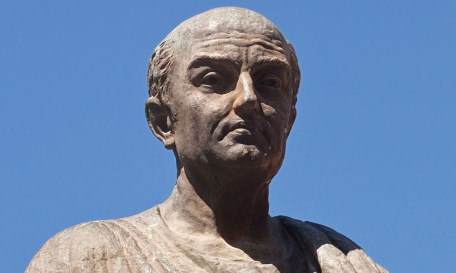
Statue of Lucius Annaeus Seneca the Younger,

Statue of Lucius Annaeus Seneca the Younger in Cordoba, Spain, by Amadeo Ruiz Olmos

Lord Macaulay once said that Seneca the Younger was easily quotable, but reading him straight through would be like “dining on nothing but anchovy sauce.”

I agree! Thus I present some of the condensed wit and wisdom of Seneca, usually on Saturdays, but today — special! — on a Monday, Leap Day, in honor of changing the schedule in order to get back on track.

EPISTLE VII. On Crowds

But nothing is so damaging to good character as the habit of lounging at the games; for then it is that vice steals subtly upon one though the avenue of pleasure. What do you think I mean? I mean that I come home more greedy, more ambitious, more voluptuous, and even more cruel and inhuman, – because I have been among human beings. By chance I attended a mid-day exhibition, expecting some fun, wit, and relaxation, – an exhibition at which men’s eyes have respite from the slaughter of their fellow-men.

But it was quite the reverse. The previous combats were the essence of compassion; but now all the trifling is put aside and it is pure murder. (*) The men have no defensive armour. They are exposed to blows at all points, and no one ever strikes in vain.

Many persons prefer this programme to the usual pairs… Of course they do; there is no helmet or shield to deflect the weapon. What is the need of defensive armour or of skill? All these mean delaying death. In the morning they throw men to the lions and the bears; at noon, they throw them to the spectators. …

You may retort: “But he was a highway robber; he killed a man!” And what of it? granted that, as a murderer, he deserved his punishment, what crime have you committed, poor fellow, that you should deserve to sit and see this show? …And when the games stop for the intermission, they announce: “A little throat-cutting in the meantime, so that there may still be something going on.

* Translator’s note: During the luncheon interval condemned criminals were often driven into the arena and compelled to fight, for the amusement of those spectators who remained throughout the day.


Seneca Epistles 1-65, Translation by Richard M. Gummere. Loeb Classical Library.

Photo credit: Gunnar Bach Pedersen, courtesy Wikimedia Commons.

Seneca on Saturday — on rising to the occasion

Statue of Lucius Annaeus Seneca the Younger,

Statue of Lucius Annaeus Seneca the Younger in Cordoba, Spain, by Amadeo Ruiz Olmos

Lord Macaulay once said that Seneca the Younger was easily quotable, but reading him straight through would be like “dining on nothing but anchovy sauce.”

I agree! Thus I present some of the condensed wit and wisdom of Seneca, every Saturday.


EPISTLE LXVII — On ill health and endurance of suffering

You say: “If it is a good to be brave under torture, to go to the stake with a stout heart, to endure illness with resignation, it follows that these things are desirable. But I do not see that any of them is worth praying for…”

My dear Lucilius, you must distinguish between these case; you will comprehend that there is something within them to be desired. I should prefer to be free from torture; but if the time comes when it must be endured, I shall desire that I may conduct myself therein with bravery, honor, and courage. Of course I prefer that war should not occur; but if war does occur, I shall desire that I may nobly endure the wounds, the starvation, and all that the exigency of war brings. Nor am I so mad as to crave illness; but if I must suffer illness, I shall desire that I may do nothing which shows lack of restraint, and nothing that is unmanly. The conclusion is, not that hardships are desirable, but that virtue is desirable, which enables us patiently to endure hardships.


Seneca Epistles 66-92, Translation by Richard M. Gummere. Loeb Classical Library.

Photo credit: Gunnar Bach Pedersen, courtesy Wikimedia Commons.
Seneca on Saturday — on what is enough

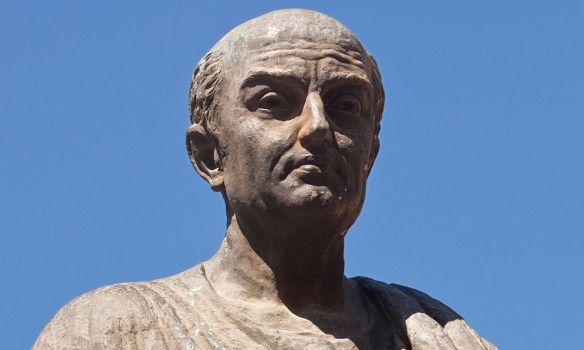
Statue of Lucius Annaeus Seneca the Younger,

Statue of Lucius Annaeus Seneca the Younger in Cordoba, Spain, by Amadeo Ruiz Olmos

EPISTLE IV: On the terrors of death

…It is the superfluous things for which men sweat,–the superfluous things that wear our togas threadbare, that force us to grow old in camp, that dash us upon foreign shores. That which is enough is ready to our hands. He who has made a fair compact with poverty is rich. Farewell.

Seneca Epistles 1-65, Translation by Richard Gummere. Loeb Classical Library.

Photo credit: Gunnar Bach Pedersen, courtesy Wikimedia Commons.

February Word of Mouth


61GagbB7KeL._SX373_BO1,204,203,200_


Graphic Novel: Dragons Beware — Jorge Aguirre and Rafael Rosado

Fiction: Capital: a Novel  — John Lanchester

Memoir: I See You Made an Effort  — Annabelle Gurwitch

Non-Fiction: The 48 Laws of Power  — Robert Greene 

Music: Bossa Nova Soul Samba — Ike Quebec 


TV: Annika Bengtzon, Crime Reporter — Amazon video.

Ancient Inspiration: “If you’re irritable, man, train yourself to put up with abuse, and not get upset when you’re insulted.” Epictetus, Discourses. 


Music and Nostalgia Part III, a radical change of mind

Is disco ancient history?

Like a politician whose “views have evolved over the years,” my feelings about disco have undergone a transformation. The rallying cry of my adolescent cohort was DEATH BEFORE DISCO. Our obsession was hard driving, often British rock. A new release from Joe Jackson, Elvis Costello, the Police, the Clash, or the Talking Heads meant sitting on the floor for repeated listenings, immersing oneself in the record jacket (often black or florescent pink or green), memorizing the lyrics (often cynical), discovering who played bass (why on earth did I care who played bass?). We listened to this music as if our lives depended on it; we defended this music as if it were under attack. Other rock and pop —the Stones, Steely Dan, Linda Ronstadt— was practically in the water supply, and didn’t require one to actively seek it out or pledge allegiance to it.

images-3

Joe Jackson Band, Beat Crazy, 1980

But the soundtrack of the time, keeping everybody’s booty shaking, was the pulsating glitter of disco —tacky, vulgar and unavoidable since Saturday Night Fever, a movie whose preening, strutting misogyny made a deep and unwanted impression on me.


The thinking teenage feminist’s logical antidote

DEATH BEFORE DISCO was the only appropriate response to the heaving, ecstatic moans of Donna Summer (Love to Love You, Baby), Diana Ross (Love Hangover) and Thelma Houston (Don’t Leave Me This Way). All these masochistic divas gyrating their pelvises and moaning about “love” was part of my problem with disco. The implicit idea that one was at the disco itself looking for sex was another issue. Looking back on it, the New Wave aesthetic —angry, angular and cerebral— was the thinking teenage feminist’s logical antidote to the mindless orgy at the disco.

1337275189338-cached

Donna Summer, in her heyday, dressed to moan


Many years, many pounds later: I have discovered that disco is an excellent motivator at the gym. Mind you, I don’t want to listen to it unless I’m suited up in lycra and strapped to a piece of equipment, when the mindless repetition of the music (Shake Shake Shake, More More More, Boogie Oogie Oogie) actually helps with the mindless repetition of the body on the machine, and drowns out whatever thumping techno yowling is currently pelting the gym. There is no better soundtrack to the skating machine than Keep It Coming, Love (KC and the Sunshine Band), Shake Your Groove Thing (Peaches and Herb), or More Than a Woman (the BeeGees), the very music I once disdained so strenuously. In fact, as tawdry as I found disco culture at the time, the music itself, and even the swaggering that surrounds it, retains an odd sweetness lo these many years later. The youthful bounce found especially at the intersection of disco and soul (e.g., Al Green, Barry White, Marvin Gaye, the Jackson 5) is very helpful when one has to kick one’s own ass around the gym. Here’s a great collection, if you need one. And check out To Disco, With Love, a kind of yearbook featuring all the ridiculous and over the top record jackets, recently published.

Untitled-1


Seneca on Saturday: ancient Roman caution

Statue of Lucius Annaeus Seneca the Younger,

Statue of Lucius Annaeus Seneca the Younger in Cordoba, Spain, by Amadeo Ruiz Olmos


Lord Macaulay once said that Seneca the Younger was easily quotable, but reading him straight through would be like “dining on nothing but anchovy sauce.”

I agree! Thus I present some of the condensed wit and wisdom of Seneca, every Saturday.

On Anger

When you are about to rejoice most, you will have most to fear. When everything seems to you to be peaceful, the forces that will harm are not nonexistent, but inactive. Always believe that there will come some blow to strike you.

Moral Essays, Volume I, by Lucius Annaeus Seneca the Younger, translated by John W. Basore. Loeb Library.

Photo credit: Gunnar Bach Pedersen, courtesy Wikimedia Commons.